
How to win back customers who haven't booked in a year, and what to text old leads
Past customers and old leads are two different lists. How to sort them, check who you can contact, what to text each one, and the consent rules to know before you send anything.

The short answer. Split people who bought from you from people who only asked for a price. Remove opt-outs and unhappy customers, check who you can contact, then send each group one short message with a reason to reply. Timing matters legally: for US sales calls to numbers on the Do Not Call Registry, the federal “established business relationship” lasts 18 months after a purchase and three months after an inquiry (FCC rules, 47 CFR 64.1200). It doesn’t replace consent for automated texts.
Who this is for. You have records of people who already know you: customers who bought once and haven’t been back, quotes that went out and never closed, and inquiries that never turned into a quote. They sit in a spreadsheet, your invoicing software or your phone, and going back to them isn’t anyone’s job.
Why do customers stop booking?
Sometimes for no reason at all. A commenter on r/smallbusiness described the pattern for work with a natural gap between visits: “Customers rarely rebook on their own for anything with a natural time gap (dental, auto, grooming, cleaning). If there’s no reminder, they just… forget, not because they didn’t like the service.”
Others left for a reason, and the reason changes the odds. In a 2015 Journal of Marketing study of a national telecoms company’s lost customers by V. Kumar, Yashoda Bhagwat and Xi Zhang, summarised by Arizona State University’s Center for Services Leadership, “customers who left for better deals were more likely to come back than customers who left due to poor service,” and “customers who left for both price and service were the least likely to come back.” That is one industry, not your business, but it gives you a sensible order: start with people who left for reasons other than poor service.
Won’t texting old customers annoy them?
Some messages will, and the ones that annoy are the ones you can avoid. In a 2021 Podium survey of 1,004 consumers in the US and Australia, reported by Small Business Trends, three-quarters said they would unsubscribe from a business’s promotional texts if they received too many, and 74% said they would be more likely to respond to a text from a business if they knew a real person was on the other end. Podium sells business texting software, so treat that as a vendor survey of stated preferences, not measured behaviour.
Both findings point the same way. One relevant message, from a person, with an easy way to say no, is not a blast. A promotional drip to everyone who ever filled in a form is.
The other version of this objection is “it looks desperate.” It looks desperate when the message has no reason except that your calendar is empty. ShiftFlow, a workforce-software company that publishes guides for contractors, puts it bluntly: “A discount cannot rescue a message with no legitimate reason,” and it advises excluding contacts “justified only by a coupon, empty week, or generic seasonal slogan.” A service that’s due, a quote they never decided on, or a question about how the work is holding up are reasons.
Is it legal to text old customers and leads?
It can be, with conditions, and the conditions depend on how you send, what you send and who you’re sending to. This is a summary of the US federal rules to take to your lawyer, not legal advice. The federal rules are in 47 CFR 64.1200, the FCC’s rules under the Telephone Consumer Protection Act (TCPA):
| Rule | What it means for an old list |
|---|---|
| Written consent for automated marketing | Autodialed or prerecorded sales calls to mobiles need it (the FCC treats texts as calls) |
| Revoking consent | Any reasonable way; honor it promptly, 10 business days at most |
| Calling hours | No sales calls before 8am or after 9pm, their time |
| National Do Not Call Registry | No sales calls to listed numbers, with exceptions |
| Established business relationship | 18 months after a purchase; 3 months after an inquiry |
The last row matters most for an old list. The established-business-relationship exception is one of the few things that let you make a sales call to a number on the Do Not Call Registry. It runs for 18 months after someone bought from you and only three months after they inquired or applied. A quote from last year is outside it. That exception also doesn’t replace the consent rules in the first row if you send by automated system.
States add their own rules. Florida, Maryland and Oklahoma, for example, have their own telemarketing laws covering automated texts, per Covington & Burling (2023). Email is covered separately by the CAN-SPAM Act: the FTC’s compliance guide says commercial email needs “a clear and conspicuous explanation of how the recipient can opt out”, your valid physical postal address, and that “you must honor a recipient’s opt-out request within 10 business days.”
Practical habits that follow from the rules, whatever you send:
- Record how and when each contact came to you, and whether they agreed to texts.
- Put an easy way to stop in every message (“Reply STOP and we won’t text again”), and honor it straight away.
- Send in daytime hours.
- When in doubt about part of the list, email it or leave it out, and ask a lawyer.
What should you text an old customer or lead?
One short message, from a named person, with one reason and one easy reply. Pick the template that matches how the person knows you. Change the names, the work and the timing.
Past customer, service due.
Hi Jordan, it’s Alex at Copperleaf. We cleaned your gutters last October, and it’s been about a year, so it may be time again. Want me to pencil you in for the week of the 10th? Reply STOP if you’d rather not hear from us.
Past customer, no obvious need.
Hi Jordan, Alex at Copperleaf here. We did your gutters in 2025. How have they held up? If anything needs a look, I’m in your area next week. Reply STOP to opt out.
Old quote, never decided.
Hi Sam, it’s Alex from Copperleaf. You asked us about a gutter replacement in the spring. Is that still something you need, or did you get it sorted? Either answer’s fine. Reply STOP to opt out.
Inquiry that never got a quote.
Hi Sam, Alex at Copperleaf. You got in touch about your gutters earlier this year and I don’t think we ever got you a price. Sorry about that. Still need it looked at? Reply STOP to opt out.
When they reply:
- “Yes” → call or offer two times the same day.
- “Not now” → “No problem. Want me to check back in the spring?” Then write the date down.
- “Got it done elsewhere” → “Glad it’s sorted. Thanks for letting me know.” Mark it closed.
- “STOP” or anything like it → stop. Mark the record so nobody contacts them again.
By email (for customers who only gave you an email):
Subject: Your gutters, a year on
Hi Jordan,
We cleaned your gutters last October, and with leaves coming down it may be time again. If you’d like us back, reply with a week that suits and we’ll confirm a time.
If you’d rather not hear from us, use the unsubscribe link below and we won’t email again.
Alex Rivera, Copperleaf Exteriors · [your postal address]
How to run a win-back yourself, smallest step first
- Ten personal texts. The quick win above: ten past customers with an obvious reason, sent by hand, answered the same day. It tells you something about your own list that no benchmark can.
- Clean the list. Merge duplicates, fix numbers, record how each contact came to you and remove opt-outs. This is the slow part, and the part that lowers your legal risk.
- Sort it into the four audiences in the table below, and write one message for each.
- Send in small batches you can answer. If you can handle five conversations a day, send to 20, not 500. Every reply should get an answer within hours, not days.
- Record what happened: booked, not now (with a date), went elsewhere, no reply, opted out. As ShiftFlow puts it, “sends and opens show activity, not reactivated revenue.” Count bookings.
- Make it recurring. Customers who say “spring” become a spring list. Once you know when people are due, regular reminders replace the one-off win-back.
Go further, for example with a managed reactivation service, when the list is too big to answer by hand, or the contact records are too messy to sort in an evening.
Doing it yourself, with software, or with help: how do they compare?
| Option | Who checks the list | Who answers replies | Your time |
|---|---|---|---|
| Personal texts from your phone | You | You | An evening, plus replies |
| Bulk texting software | You | You | Setup, then replies |
| Agency “reactivation” offer | Varies; ask | Ask | Low, until problems |
| Managed reactivation service | The service | The service, then you | Approving messages |
Agencies sell “database reactivation” to owners, and some vendors sell the offer to agencies: one April 2026 guide written for AI agencies suggests framing it as “found money”, with pay-per-appointment first among its suggested pricing structures. Some of these offers are fine. Ask the questions in the box below before you hand over your list.
Who should you contact first?
People with the strongest reason to hear from you, and the clearest permission. The diagram below is the sort to run before you send anything.
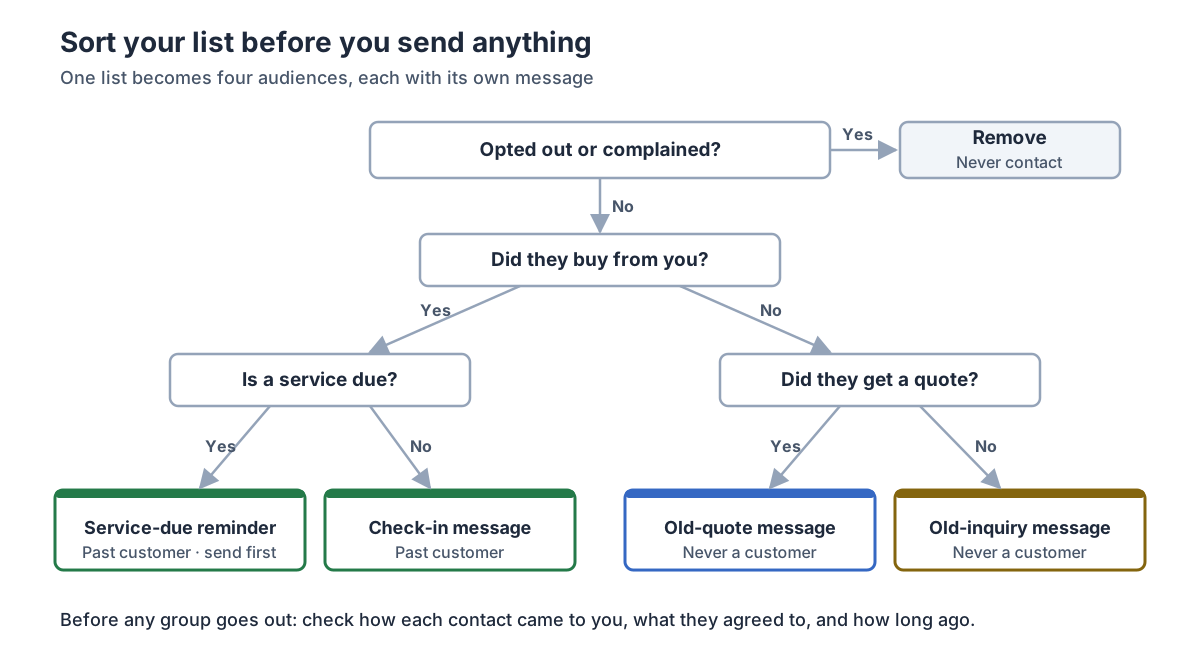
| Audience | Reason to reply | Start with |
|---|---|---|
| Past customer, service due | The work is due again | First, check consent |
| Past customer, no clear need | A check on how it held up | Second, check consent |
| Old quote, never decided | The job may still need doing | Third, check consent |
| Inquiry, never quoted | You never got them a price | Last, check consent |
| Opted out or complained | None | Never |
What it’s worth: a worked example
Example, not a statistic. We found no independent study of reactivation reply or booking rates, so every input below is an assumption. Swap in your own.
- Your records hold 800 contacts. 300 are past customers whose last job was 12 to 18 months ago; the rest are old quotes and inquiries.
- After removing opt-outs, complaints and bad numbers, 250 past customers are left. 120 of them have a service that’s due.
- You text those 120. Suppose 18 reply wanting the work and 12 book.
- An average repeat job is worth $350.
That’s 12 jobs and $4,200 of work from people who already knew you, at the cost of the list cleaning, the messages and an hour or two of replies. If only 4 book, it’s $1,400, and you’ve still cleaned the list and learned who is due when. Run the old quotes as a separate test with their own numbers; they aren’t past customers, and they won’t behave like them.
Numbers we left out
These figures turn up in win-back and reactivation pitches. We traced them and didn’t use them.
- “It costs 4 to 10 times less to reactivate an old customer than to acquire a new customer.” It appears in a Referrizer help article with no source.
- “A 5% increase in retention raises profits 25–95%.” It was written about “e-companies”, with no study behind the range; the trace is in What is a Growth System?
- A 27% chance of working with a provider again after one job, and 54% after a second or third. It appears on a Housecall Pro page, linked only to another vendor’s blog post, with no study named.
Where this breaks down
- There’s no benchmark. We found no independent study of reply or booking rates for small-business reactivation. Vendor case studies are self-reported.
- Old data is wrong data. People change numbers and move. Expect bad numbers, and remember that a reassigned number belongs to someone who never agreed to hear from you.
- It can’t undo a bad experience. Customers who left unhappy need a different conversation, and some shouldn’t be contacted at all.
- The legal summary above is federal and US-only. State rules differ, and how you send matters. Check with a lawyer.
- It’s a one-off unless you keep going. A win-back finds who is due; staying in touch afterwards is what stops the list going cold again.
How Leadio does it
Leadio’s Win-Back Campaign runs this for you. We review your existing list, remove duplicates where scoped and establish who can be contacted for the campaign. We plan separate campaigns for old inquiries and former customers, because someone who asked but never bought is not a past customer. You approve the message, channel and any offer before anything goes out. We manage replies within the remit you agree, route interested people into booking or a sales conversation, and report recorded outcomes. There’s no promise that it pays for itself or produces a particular revenue figure, delivery and messaging costs still apply, and we aren’t your lawyers: if part of your list needs a legal view, get one before it goes out.
Ongoing reminders to the customers you win back belong to the Lifetime Value Builder.
Read how the Win-Back Campaign works, and when you’re ready, bring a rough count of past customers, open quotes and old inquiries: book a 20-minute list review.
FAQ
How do I get old customers to come back? Give them a real reason to hear from you, such as a service that’s due, in one short personal message with an easy way to reply or opt out, and answer every reply quickly.
What should I text old leads? Remind them what they asked about and ask whether it’s still needed: “You asked us about a gutter replacement in the spring. Is that still something you need?” Include a way to opt out.
Is it legal to text past customers? It can be, with conditions. In the US, automated marketing texts need prior express written consent; sales texts to numbers on the National Do Not Call Registry need signed, written permission or an established business relationship (18 months after a purchase, three after an inquiry); people can revoke consent in any reasonable way; and states add their own rules. This is not legal advice; check with a lawyer for your list.
How long after a purchase can I contact a customer? For sales calls to numbers on the Do Not Call Registry, the federal established-business-relationship exception lasts 18 months after a purchase and three months after an inquiry. Consent rules for automated texts apply separately.
What is database reactivation? A campaign to reconnect with people already in your records: former customers and old inquiries, contacted separately, with a reason to reply.
Win-Back Campaign
Reactivate old leads and past customers through separately planned win-back campaigns.
More from keep customers coming back.
AI receptionist vs answering service: what each answers, what each books, and what callers hear
An AI receptionist and a live answering service both pick up the phone. Compare them by what gets answered, what gets booked and who does the work after the call, and start with the hours you actually miss.
Are your Facebook leads junk, or just slow to reach?
Before you blame Meta for bots, check how fast your team called. Facebook lead forms are built for volume by default, and a lead reached the next day is a different lead. A three-question check, the form settings to change, and when to go further.
Can an AI clone of you post for your business, and should it?
An AI clone built from your voice and likeness can deliver videos you never filmed. Whether it helps or costs you trust comes down to consent, disclosure and what you use it for. What the research says, how the capture session works, and when not to use one.
See where your leads are leaking.
Find out which stages are leaking, who we'd staff to plug them, and which Growth Team follows.