
What Is a Growth System? The full service menu, and the order to fix things in
A Growth System is the set of jobs that turn attention into booked, kept customers, run as one thing. Here is the full menu, which services to fix first and why, and a way to map your own business for free.

The short answer. A Growth System is every job between someone finding your business and someone paying you again, run as one thing: answering, following up, closing, reviews, keeping in touch, being found, and advertising. The order matters. Fix how you handle the inquiries you already get before you buy more of them. In a 30-day study of 85 small businesses by the marketing firm 411 Locals (2016), about 62% of calls weren’t answered by a person. If your calls go the same way, more leads buy more calls nobody picks up.
Who this is for. You sell through an inquiry, an estimate or an appointment. You’re looking at “done-for-you marketing”, an all-in-one platform or a list of a dozen services, and you want to know which of them you actually need, and in what order.
What is a Growth System, in plain terms?
It is the growth department a larger company would employ, with its jobs listed out and each given an owner. A new website is a project. Answering the inquiries it creates is a standing job. An ad campaign is a project. Following up the people who respond is a standing job. A Growth System is the standing jobs, run together, so the handoffs between them have an owner too.
A growth department, at any size, does seven things:
- Gets found. Search, maps, social and, when the numbers work, paid ads.
- Responds. Calls, forms, texts and messages get a useful answer while the buyer still cares.
- Books. Interest becomes an appointment, a visit or an estimate.
- Follows up. Quiet quotes and missed appointments get a next step until there’s a yes or a no.
- Closes. The person selling has the context and the practice to win the work.
- Keeps. Customers get checked on, asked for a review, and reminded when it’s time to come back.
- Measures. Someone looks at where opportunities stop moving, not just at clicks.
A small business has the same seven jobs, but they can end up spread across people whose main job is something else: the owner answering messages between estimates, an office manager checking the web form when the phone settles down, a technician who remembers to ask for a review. Everyone may be working hard. A job that belongs to everyone in general can belong to nobody at the moment it matters.
”Isn’t this just an all-in-one bundle? Why can’t I buy the one thing I need?”
You can, and sometimes you should. Every service on the menu below can be bought on its own, and if only one stage of your business is leaking, one service may be all you need.
The difference between a Growth System and a bundle isn’t the number of things in the box. It’s the order and the handoffs. A bundle that adds ads, a website and a review tool still leaves the question of who calls the ad leads back, who notices the booked estimate that didn’t show, and who tells the person posting on social media which questions keep stalling sales. When each vendor manages only the part it was hired for, the gaps between them stay with you.
What’s on the menu?
The services fall into four groups, and each one fixes a specific leak.
| Group | Services | Fixes |
|---|---|---|
| Turn leads into customers | 24/7 Answering Service, 24/7 Chat & DMs, Lead Nurture Ladder, Closing Coach, Review Booster, Website Optimization | Missed calls, slow replies, quiet quotes, lost sales |
| Keep customers coming back | Lifetime Value Builder, Win-Back Campaign, Referral Engine | Forgotten customers, a quiet database |
| Get found | Local SEO & AI Answers, Social Media Management, Paid Advertising Management, Cold Outreach | Too few of the right inquiries |
| Run on better systems | Business Brain & Knowledge Base, AI Agent Development, Process Automation, Custom Development & Integrations | Slow manual steps, AI that doesn’t know your business |
Which services should I fix first, and why?
Get the house in order first, then make yourself easier to find, and buy demand last. Each later step sends more inquiries into the earlier ones, so fixing the earlier ones first means the money you spend later lands somewhere that holds.
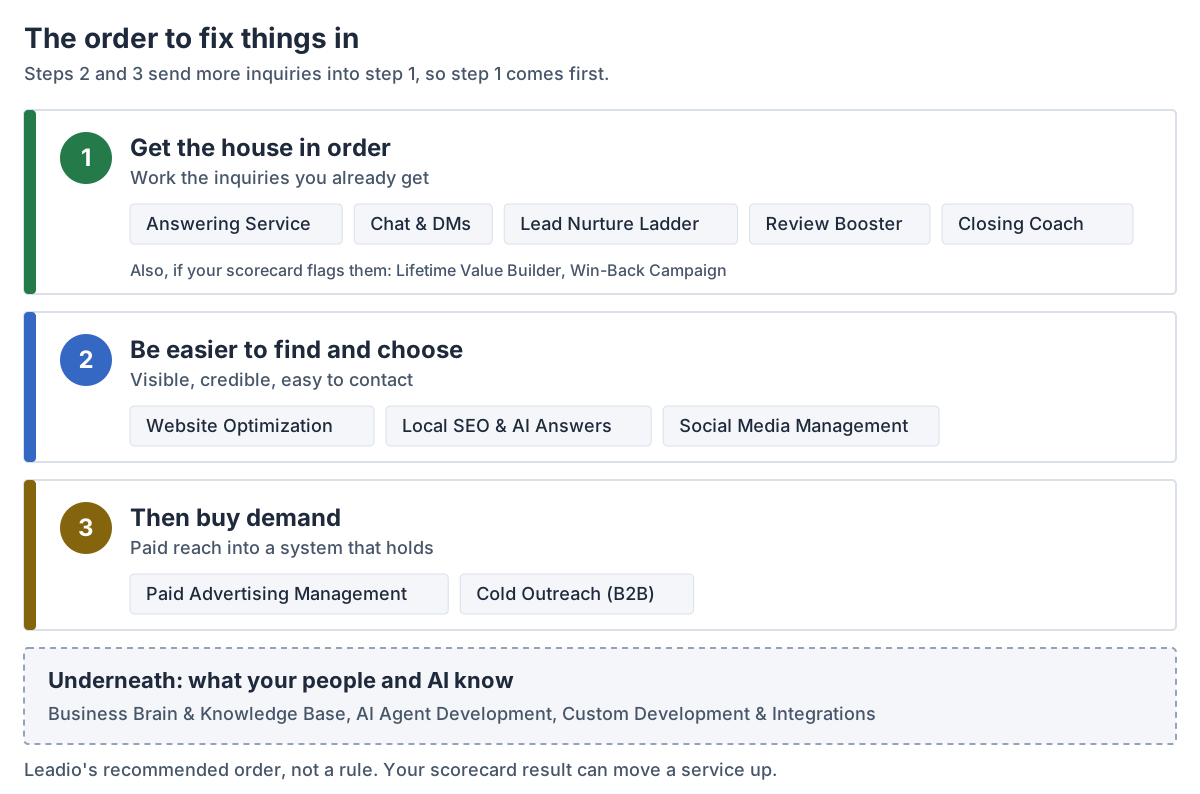
Step 1: Get the house in order. Answer every inquiry, follow it up until there’s a decision, check in after the job and ask for the review. These work the leads you already pay for. Add sales coaching if booked appointments don’t turn into won work, reactivation if your list holds old quotes and lapsed customers, and process automation if prices take days to go out.
Step 2: Be easier to find and choose. Once inquiries are handled well, make more people able to find you and trust you: a website that works on a phone, a current Business Profile, and a social presence that shows real work. If your website is broken on a phone, move it into step 1; a visitor who can’t contact you never becomes an inquiry.
Step 3: Then buy demand. Paid ads buy reach directly, and they also multiply whatever happens after the click. Run them once steps 1 and 2 hold, and judge them by cost per booked job. Our guide to hiring marketing help covers what to own and what to ask.
Underneath: what your people and AI know. If an AI answers your phone or chat, it can only be as right as the information it’s given. A business brain, meaning the prices, services, rules and answers written down in one place, sits under every AI-run service, whether you write it yourself or buy help with it.
How do I map my own Growth System for free?
You need a blank page and an honest hour.
- List the jobs as actions, not departments or software: answer new inquiries, qualify them, book the next step, confirm attendance, recover no-shows, follow up open estimates, ask for reviews, reply to reviews, check in after the job, invite past customers back, prepare the salesperson, keep the website and profile current, run paid ads, look at where opportunities stop.
- Write a person’s name next to each. A company counts only if a named person there owns the outcome. Software doesn’t count: it can help with a job but can’t be accountable for it. “The team” doesn’t count without a named owner.
- Write the trigger and the finish line. What tells the owner to start? What record proves it’s done? “Follow up leads” is vague. “Every open quote gets a message on day 2, 7 and 14, then a yes-or-no question, recorded in the job list” is a job.
- Look at the blanks and at the names carrying too many jobs. A name on the page isn’t the same as enough time to do the job.
- Trace a real inquiry across the page. Not what normally happens; what actually happened. Where it stalled is where to start.
- Fix one stage, then re-check after 30 days. Only then decide whether the next fix is a hire, a tool or a service.
What are my options for running it?
| Option | What gets done | What gets booked | Who does the work |
|---|---|---|---|
| Separate vendors | Each vendor’s own part | Not tracked end to end unless you ask | Vendors, plus you on the handoffs |
| All-in-one software | Tools: texts, contact records, reviews | What the tools can book | You set it up and run it |
| Agency bundle | Marketing, sometimes a website | Depends on the report | The agency, for marketing |
| Managed Growth System | Several stages, in order | Tracked to bookings where measurable | The provider, with your sign-off |
| In-house hires | What each person covers | Depends on hours covered | Your staff |
A low-cost software bundle can be the right call if you have someone with time to run it. The question to ask is who does the work after the software sends its text.
Why does the order matter? A worked example
Example, not a statistic. Every input below is an assumption. Swap in your own.
- 40 inquiries a month today; 25 of them get a useful reply the same day.
- Of the inquiries that get a same-day reply, 1 in 3 books. The rest book rarely enough that we count them as zero here.
- After the handling is fixed, 9 in 10 inquiries get a same-day reply.
That’s about 8 booked jobs a month.
| Choice | Inquiries | Answered same day | Booked |
|---|---|---|---|
| Today | 40 | 25 | about 8 |
| Buy 20 more inquiries, same handling | 60 | about 38 | about 12–13 |
| Fix handling first, no new ad spend | 40 | 36 | 12 |
| Fix handling, then buy 20 more | 60 | 54 | 18 |
Buying more inquiries and fixing the handling each add about 4 bookings in this example, but only one of them comes with a monthly ad bill. Doing both, in that order, adds about 10. If you think your unanswered inquiries wouldn’t book at 1 in 3 even when answered, lower that rate for them and recalculate.
Numbers we left out
We’ve seen these figures in “why you need a growth system” pitches. We traced them and didn’t use them.
- “A 5% increase in retention raises profits 25% to 95%.” The trail leads to Bain & Company’s Frederick Reichheld. The Bain essay we found states it for “e-companies” (Bain) without the study behind it, and later posts repeat it.
- “A new customer costs 5 to 25 times more than keeping one.” The 2014 HBR post we traced it to opens “Depending on which study you believe”, and names no study for the range.
- “$126,000 a year lost to missed calls.” We found it only in vendor posts that don’t show the workings, sometimes credited to an Invoca “2022 Call Intelligence Report” that we couldn’t find. The worked example above shows the arithmetic with your own inputs instead.
Where this breaks down
- It can’t fix the offer. A Growth System can’t make a weak offer compelling, create delivery capacity you don’t have, or close a deal the owner won’t close. It can show those limits sooner.
- Doing everything at once makes it hard to learn. In our experience, staffing every job at the same time creates noise and makes it hard to see what changed. Fix one stage, measure, then move.
- Automation doesn’t remove the owner. Software and AI help with coverage, reminders and drafting. A person still sets the standard, handles the exceptions and is accountable for the result.
- The map only works if it’s honest. If an inquiry is marked “bad lead” because nobody reached it, or a quote “lost” without an answer, the map becomes fiction.
- The order is our recommendation, not a law. A business with excellent handling and an empty calendar should go straight to step 2 or 3.
How Leadio does it
The Leadio Growth System is a managed package covering the conversion and customer stages above, with the order of fixes agreed in your plan. Marketing, outreach and build projects from the same menu are scoped and priced separately, and each live service can also be bought on its own terms. We set up the agreed work, run it and review it with you, so the gaps between services have an owner. For marketing services such as Paid Advertising Management, ad spend goes directly to the platforms, and we don’t charge a percentage of it.
The package comes with a 60-day promise: more qualified appointments in 60 days than the 60 before, or we work for free until you do. The baseline is confirmed during onboarding, and there is no guarantee on rankings, revenue or ad results. Standalone services have their own terms.
To see where to start, take Find Your Leaks: yes-or-no questions about your own business, about 90 seconds.
FAQ
What is a Growth System? The set of jobs that turn attention into booked, kept customers, from answering inquiries to reviews to advertising, each with an owner and run together.
Is a Growth System the same as done-for-you marketing? Not quite. The done-for-you marketing offers we looked at mean someone else runs your ads, SEO or social. A Growth System includes those, but starts with what happens after the inquiry arrives.
Do I have to buy the whole Growth System? No. Each live service can be bought on its own. The package makes sense when several stages leak at once and the handoffs between them matter.
Should I fix my follow-up or run ads first? Follow-up first, unless your handling is already strong. Ads send more inquiries into the same process; if it loses people, the ads pay for more of the loss.
Where does AI fit in? In the jobs that need speed and consistency, like answering at any hour and keeping follow-up on schedule, with people handling judgment calls and exceptions. Any AI that talks to your customers needs your business’s information written down first.
More from growth system field notes.
Where are your leads leaking? A scorecard for businesses that sell by inquiry, estimate or appointment
A free scorecard you can run on your own business in about an hour: one test for each leak in a six-stage frame, from the first review a buyer reads to the customer who never hears from you again.
Who owns your ad accounts? What to ask before you hire marketing help, and how to tell if it's working
An ownership checklist, the contract terms to read before you sign, and the number that shows whether marketing help is working: cost per booked job. Free to use with any agency, freelancer or provider.
The Empty Desks in Most Service Businesses
Walk the floor of your business as if every growth responsibility had a desk. The empty ones explain more lost revenue than anything your competitors are doing.
See where your leads are leaking.
Find out which stages are leaking, who we'd staff to plug them, and which Growth Team follows.