
Where are your leads leaking? A scorecard for businesses that sell by inquiry, estimate or appointment
A free scorecard you can run on your own business in about an hour: one test for each leak in a six-stage frame, from the first review a buyer reads to the customer who never hears from you again.

The short answer. Before you buy more leads, check where the ones you already get stop moving. Most of the leaks below sit after the inquiry arrives: the call nobody answers, the form nobody replies to, the quote nobody chases. In a 2011 Harvard Business Review audit of 2,241 US companies, 23% never responded to a web inquiry at all. The scorecard below gives you a yes-or-no test for each leak, and the fix for each.
Who this is for. You sell through an inquiry, an estimate or an appointment. Someone calls, texts, fills in a form or messages you, and the sale depends on what happens next: a reply, a booked visit, a price, a follow-up, and a reason to come back. You suspect you are losing work somewhere, and “we need more leads” is the explanation you keep hearing.
Why am I not getting more customers when I’m getting leads?
Because a lead and a customer are separated by several steps, and each step can fail without anyone noticing. A buyer has to trust you, find a way to contact you, get an answer, get followed up, get a price they say yes to, and then hear from you again. If any one of those steps has no owner, the lead can stop there, and it can look like a quiet month rather than a leak.
The scorecard splits those steps into six stages. It is the same frame behind Find Your Leaks, Leadio’s 90-second online check, but here you run it yourself, with the tests written out.
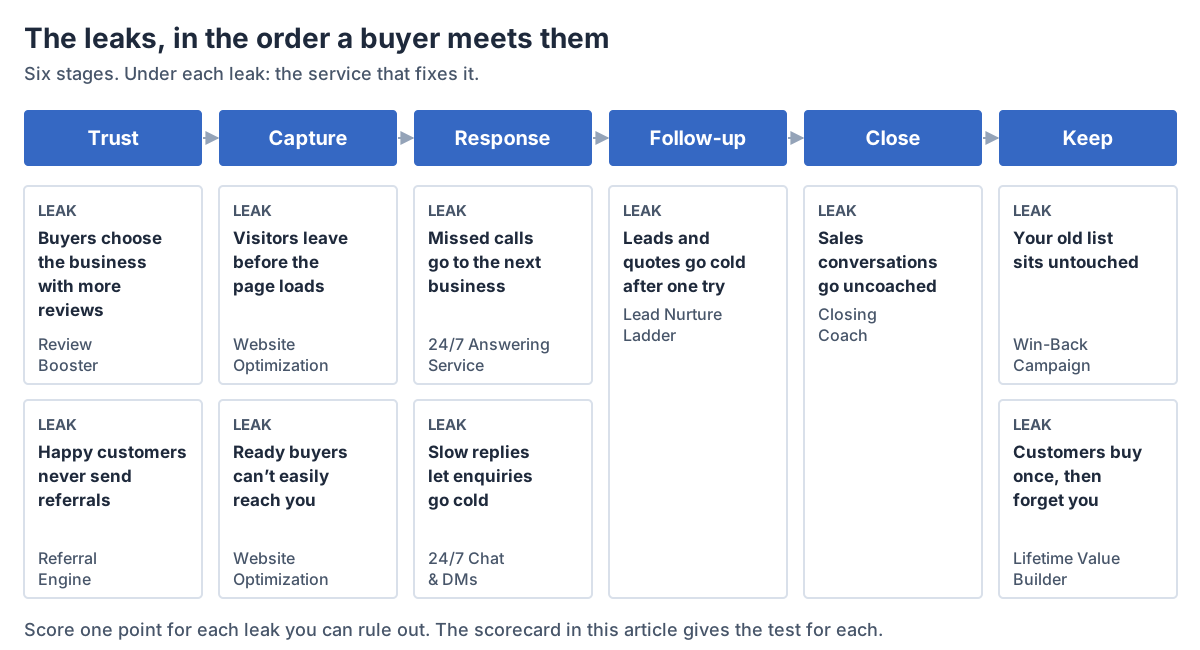
”My problem isn’t leaks. I just need more leads.”
You may be right, and the scorecard will tell you. If you pass every test, or all but one, your house is in order and more demand is the sensible next step. Some owners push back on the leak idea. On r/smallbusinessowner, one commenter replied to a post about missed calls: “The ‘missed call problem’ isn’t a problem. Everyone seems to think it is…” (thread).
The reason to check first is cost. Every lead you already get has been paid for, in ad spend, in years of reputation or in a referral someone gave you. A commenter on r/hvacadvice, who disclosed they are a vendor, put the pattern this way: “the missed call itself is only half the leak. The other half is that nobody owns what happens next… ‘same day’ quietly becomes ‘tomorrow’” (thread). If that is happening, more leads feed the same gap.
The scorecard: one test per leak
Score one point for each test you pass. “Not sure” scores zero, because a leak you can’t see is still a leak. Each test takes a few minutes; the whole card takes about an hour.
Trust: do they trust you?
- Recent reviews. You have a new Google review from the last 30 days, and every review from the last 90 days has a reply. If not: Review Booster.
- Referrals. You know how many referrals you got in the last 12 months, and each person who referred you was thanked. If not: a referral routine, such as Leadio’s Referral Engine.
Capture: does your website turn a visitor into an inquiry?
- Phone test. On mobile data, your main service page loads in a few seconds, the phone number is tappable and the contact option is visible without hunting. If not: Website Optimization.
- After-hours door. At 9pm, a visitor can ask a question or book a time, not only fill in a form and wait. If not: website paths plus 24/7 Chat & DMs.
Response: how fast does anyone answer?
- Call test. Your 12:30 and 6:15pm test calls reached a person or something that could help and book. If not: the 24/7 Answering Service.
- Form test. Your 8pm test inquiry got a useful reply within an hour. If not: forms connected through Website Optimization, answered by 24/7 Chat & DMs, which answers website chat, texts and Facebook and Instagram DMs around the clock.
Follow-up: are leads worked until yes or no?
- More than one attempt. Every new inquiry that doesn’t book on first contact gets several more attempts, and every open quote has a next step with a date and a name. If not: the Lead Nurture Ladder.
Close: do they say yes?
- Call review. Someone listened to a recorded or shadowed sales conversation in the last month and gave the salesperson specific feedback. If not: Closing Coach.
Keep: do customers stay and return?
- Your database. You know how many past customers and old inquiries have gone quiet, and when each last heard from you. If not: a Win-Back Campaign.
- Staying in touch. Your past customers heard something useful from you in the last six months: a reminder, a check-in or an offer that fits what they bought. If not: the Lifetime Value Builder.
Reading your score
| Score | What it suggests | Where to start |
|---|---|---|
| 9–10 | The house is in order | Add demand: search, social or ads |
| 6–8 | One or two stages leak | The stage with the most zeros |
| 0–5 | Leads stall in several places | Response first, then follow-up |
These bands are our rule of thumb, not a benchmark. When two stages tie, we suggest Response first, then Follow-up, because those leaks lose people who have already contacted you.
How do I fix a leak without buying anything?
Start with the smallest change that covers the biggest gap, run it for 30 days, and only then decide whether you need help. Here is the order we would use:
- Score the card honestly (one hour). Run the tests rather than answering from memory. Write the date on it.
- Pick one stage. The one with the most zeros. If two tie, pick Response, then Follow-up. Ignore the rest for now.
- Make the smallest fix. For Response, that might be forwarding unanswered calls to a second phone during working hours and turning on a text reply for missed calls. For Follow-up, write one rule (“every open quote gets a message on day 2, day 7 and day 14, then a yes-or-no question”) and put the dates in a calendar. For Keep, send one useful message to last year’s customers.
- Give the fix an owner and a check. A name, and a weekly look at whether it happened. A fix that depends on someone remembering can stop when the week gets busy.
- Re-run the tests after 30 days. Same calls, same test form, same quote count.
- Go further only where the small fix didn’t hold. If the test call at 6:15pm still goes nowhere, or the follow-up rule lapsed in week three, that leak needs someone whose job it is, whether that is a hire, a provider or a managed service.
What are my options for fixing the leaks I find?
| Option | What gets done | What gets booked | Who does the work |
|---|---|---|---|
| Do it yourself | The one or two fixes you keep up | Depends on your week | You or your team |
| Software alone | Automated texts, reminders, inbox | Only what the tool can book | You set it up and watch it |
| One specialist provider | One stage covered well | Their stage only | The provider, for one stage |
| A managed set of services | Several stages, run together | Tracked to bookings where measurable | The provider, with your sign-off |
Software can send a text back after a missed call. It won’t make sure someone acts when the reply goes unanswered unless a person owns it. A single provider can run one stage well and still leave the handoff to the next stage with you. The more stages leak, the more the handoffs matter.
What could one leak be worth? A worked example
Example, not a statistic. Every input below is an assumption. Swap in your own.
- 40 new inquiries a month.
- 10 of them wait more than a day for a reply, or never get one (the form test).
- When someone reaches an inquiry promptly and asks for the booking, 1 in 3 books.
- An average job is worth $1,500 to you.
If those 10 slow inquiries got a useful reply within the hour and booked at the same 1 in 3, that is about 3.3 more booked jobs a month, or about $5,000 of work, from inquiries you already paid for. If you think late replies would book at a lower rate even when answered fast, lower the 1 in 3 for those 10 and recalculate. Then compare the answer with what 3.3 extra booked jobs would cost you in new ad spend.
Numbers we left out
These figures turn up in articles about lost leads. We traced them and didn’t use them.
- “78% of customers buy from the first company to respond.” We couldn’t find the survey it is credited to; the trace is in Are Facebook leads fake?
- “85% of people whose calls aren’t answered won’t call back.” No study behind it that we could find; traced in AI receptionist vs answering service.
- “$1,200 lost per missed call.” It isn’t in the source it is credited to; traced in How much does an AI receptionist or answering service cost? The worked example above shows how to put a value on a leak from your own numbers instead.
Where this breaks down
- The scorecard finds symptoms, not causes. A failed call test tells you calls go unanswered. It doesn’t tell you whether the fix is coverage, routing or staffing.
- These tests can’t cover every business. If you sell through long tenders or a single annual contract, some tests won’t fit. Drop them and score out of fewer.
- One test call is one data point. Run the call and form tests on more than one day before you act on them.
- The bands are judgment. A score of 9 with the missing point in Response can matter more than a score of 7 with the gaps in Keep.
- The cited figure is old and broad. The HBR audit of 2,241 US companies is from 2011 and didn’t measure businesses like yours specifically. Your own test results are more useful.
For more on the response and follow-up figures behind the scorecard, see The Empty Desks in Most Service Businesses.
How Leadio does it
Every leak on the scorecard maps to a named service, and the Growth System is the managed package that runs them together, with the order of fixes agreed in your plan. Response leaks go to the 24/7 Answering Service, an AI receptionist run for you that answers the calls in your scope and hands urgent or complex matters to the people you nominate, and to 24/7 Chat & DMs for website chat, texts and DMs. Try it at the voice demonstration. Follow-up leaks go to the Lead Nurture Ladder. Each service can also be bought on its own.
If you’d rather not run the tests by hand, take Find Your Leaks: yes-or-no questions about your own business, about 90 seconds.
FAQ
What is a lead leak? A point between someone finding you and someone paying you where an interested buyer drops out: a missed call, a slow reply, a quote nobody chased, a customer who never heard from you again.
Why am I getting leads but no sales? Check first whether a step after the inquiry has no owner. Run the Response and Follow-up tests above first. If they pass, look at Close: how long it takes to get a price out, and whether anyone reviews sales conversations.
How fast should I respond to a new inquiry? Within the hour is a reasonable floor to test against; faster is better. What the research on response speed found, and its limits, is in Are Facebook leads fake?
Should I fix leaks before running ads? If you score below 9, yes. Ads add inquiries to the same steps. If those steps lose people, the ads pay for more of the loss.
Is the online Find Your Leaks check the same as this scorecard? It uses the same six stages. The online version asks yes-or-no questions and shows your result; this article gives you the tests to run by hand.
More from growth system field notes.
Who owns your ad accounts? What to ask before you hire marketing help, and how to tell if it's working
An ownership checklist, the contract terms to read before you sign, and the number that shows whether marketing help is working: cost per booked job. Free to use with any agency, freelancer or provider.
The Empty Desks in Most Service Businesses
Walk the floor of your business as if every growth responsibility had a desk. The empty ones explain more lost revenue than anything your competitors are doing.
What Is a Growth System? The full service menu, and the order to fix things in
A Growth System is the set of jobs that turn attention into booked, kept customers, run as one thing. Here is the full menu, which services to fix first and why, and a way to map your own business for free.
See where your leads are leaking.
Find out which stages are leaking, who we'd staff to plug them, and which Growth Team follows.