
How much does an AI receptionist or answering service cost? Compare it by cost per booked job
Ruby’s live receptionists bill by the minute, Smith.ai’s AI receptionist by the call, and a receptionist on staff by salary. None of those tells you what a booked job costs. Here is how to work that out with your own numbers.

The short answer. The published prices we checked came in three shapes: per minute (Ruby’s live receptionists), per call (Smith.ai’s AI receptionist), and a salary for a receptionist on staff. The US Bureau of Labor Statistics puts median receptionist pay at $38,010 a year (2025). None of those prices tells you what you pay per booked job. That number, plus the hours you spend calling people back, is the one to compare.
Who this is for. You sell through an inquiry: someone calls, and the sale depends on getting them to an appointment, an estimate or a visit. You are weighing voicemail, a live answering service, an AI receptionist or a hire, and the price lists don’t line up.
How are answering services and AI receptionists priced?
Three published examples show the three shapes. This is what each looked like in October 2026:
- Per minute, live. Ruby’s published plans start at 50 minutes for $250 a month, with 100 minutes for $395. Its pricing comparison page says it bills per minute, rounded up; the page gives both 30-second and 60-second increments.
- Per call, AI. Smith.ai’s AI receptionist pricing has a free plan of 25 calls and a Pro plan at $150 a month that includes 75 calls ($2.00 a call), with extra calls at $2.50. It is month to month with 30 days’ notice.
- Salary. The BLS median of $38,010 a year ($18.27 an hour, May 2025) is wage only, before taxes and benefits, and most receptionists work full time. A full-time hire covers one person’s working hours; evenings and weekends need separate cover.
These are list prices from vendors, and they change. They tell you what a minute or a call costs, not whether that minute ended in a booking.
Isn’t voicemail free?
Voicemail costs nothing a month, but you pay for it in callbacks and in callers who never leave a message. For the callers who leave a message and pick up when you ring back, it works. For the rest, see what callers do when they reach voicemail.
And if all-day cover is more than you need, you don’t have to buy it. Covering only after hours and the calls you can’t pick up can cost less on per-minute and per-call plans, because fewer calls reach the service, though plan minimums still apply. The measured approach is in our comparison article.
How do you work out cost per booked job?
Add what the option costs you each month to the value of your callback time, then divide by the jobs it books.
Cost per booked job = (monthly cost + callback hours × your hourly value) ÷ booked jobs
A measured approach to choosing
- Get your baseline. Use the quick wins: calls, minutes, missed calls, bookings from the phone, callback time.
- Price only the gap. Ask for quotes on the calls you miss (after hours and overflow), not every call.
- Ask each provider what a booked job needs. Does it book on the call, or hand you a message to return?
- Run the formula for voicemail, your current setup and each quote, using the same inquiry count.
- Try the cheapest option that books on the call for a month, and compare the booked jobs against your baseline before you widen the hours.
How do the options compare on what you get for the money?
| Option | Billed by | Books on the call? | Your work after |
|---|---|---|---|
| Voicemail | Free | No | Every callback |
| Staff receptionist | Salary, their hours | Yes | After-hours calls |
| Live service | Minutes or calls | If given your calendar | Callbacks from messages |
| AI receptionist software | Minutes or calls | If you connect it | Setup, checks, fixes |
| Managed AI answering | Agreed scope | Where your calendar is connected | The handoffs you agree to take |
The “your work after” column is the cost a price list leaves out. A message-taking service that hands you 12 messages a month also hands you 12 callbacks. AI receptionist software you set up yourself can be the cheapest line on the invoice and still take your evenings, because someone has to write its answers, read its calls and fix what it got wrong.
Worked example: three options, same calls
Example, not a statistic. Every input below is an assumption. Swap in your own.
- 30 calls a month arrive when nobody can answer (evenings, weekends, on a job).
- 15 of them are new-job inquiries.
- When someone actually talks to an inquiry and asks for the booking, 1 in 3 books.
- Each callback attempt takes you 5 minutes, including the ones that ring out.
| Option | Conversations (assumed) | Booked jobs | Callbacks you make |
|---|---|---|---|
| Voicemail, call back next morning | You reach 5 of 15 | about 1.7 | Up to 30 |
| Message-taking service | 12 of 15 leave details; you reach 7 | about 2.3 | 12 |
| AI receptionist that books | 11 talk to it; 4 hang up | about 3.7 | 4 |
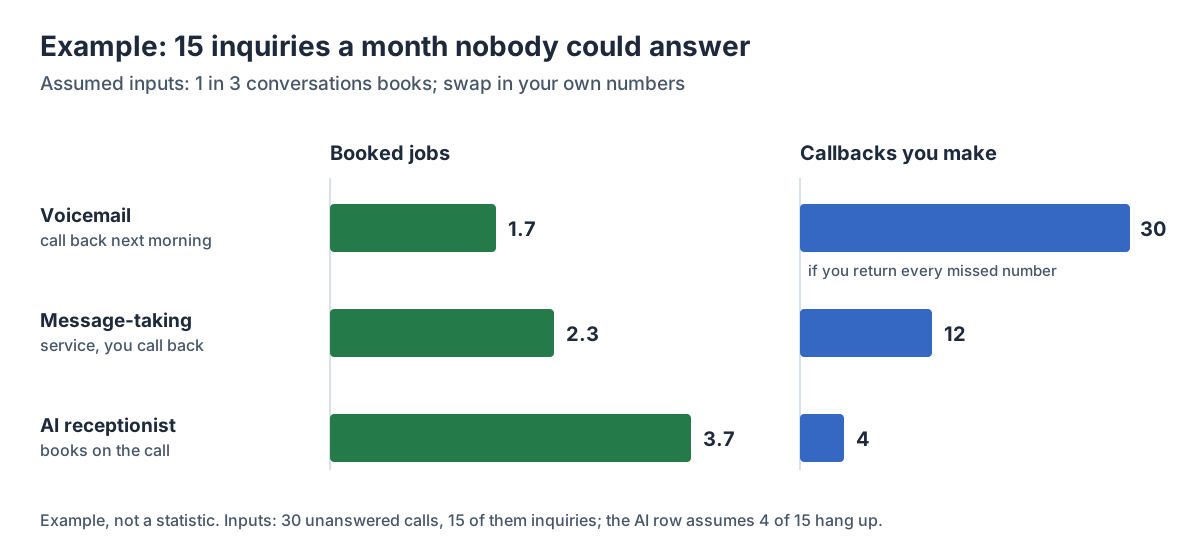
Now put money on it. Callback time: up to 30 callbacks is 2.5 hours a month, 12 is 1 hour, 4 is 20 minutes. Booked jobs: the option that books 3.7 brings in 2 more jobs a month than voicemail. If each job leaves you $400 after costs, those 2 jobs are worth $800 a month, plus about 2 hours of callbacks you didn’t make. That is the most the booking option could cost you before it stops beating free voicemail. Run the same sum for the message-taking service: about 0.7 more jobs than voicemail is worth about $270 at that margin.
Then stress-test it. If 8 of the 15 hang up on the AI instead of 4, 7 still talk to it and about 2.3 book, which matches the message-taking row and leaves you 8 callbacks instead of 12. If you think your callers book less often with an AI, lower its 1 in 3 and see where it lands.
Numbers we left out
These figures turn up in pricing articles. We traced them and didn’t use them.
- “About $1.25 a minute” for live answering and “pennies a minute” for AI. We couldn’t trace either to a source, and Smith.ai’s published AI receptionist pricing, for one, is charged per call, not per minute.
- “$1,200 per missed call.” Some vendor blogs credit it to Invoca’s 2024 post on missed calls, and it isn’t in that post.
- “Benefits add 29.4% on top of wages.” This misreads federal employer-cost data, which reports benefits as a share of total compensation, not an amount added on top of wages. In the BLS employer costs release for June 2026, benefits were 30.0% of private-industry compensation. We used the BLS wage figure on its own.
Where this breaks down
- The worked example is arithmetic, not a forecast. The 1 in 3 booking rate and the hang-up counts are assumptions. Your own month of data replaces them.
- Vendor prices move. The Ruby and Smith.ai figures are list prices seen in October 2026. Check the current page and your own quote.
- A booked job isn’t a paid job. Cancellations and no-shows come after the booking. Count jobs completed, not only appointments made.
- Some calls shouldn’t be priced this way. A distressed caller or a complaint needs a person, whatever the cost per call.
How Leadio does it
Leadio’s 24/7 Answering Service is an AI receptionist run for you as a managed service, not software you set up and maintain yourself. It answers around the clock by default, and you can limit it to after hours and the calls you can’t take. Your proposal lists what the AI and your team each handle. It asks your qualifying questions, and can book suitable inquiries where your calendar is connected. Urgent or complex matters go to the people you nominate with the conversation attached. Our team reviews the conversations and corrects the answers, which is the “your work after” column in the table above.
Inquiries that don’t book on the first contact are the job of the Lead Nurture Ladder.
Try it at the voice demonstration, then see what it would look like for your business.
FAQ
How much does an answering service cost per month? It depends on your minutes or calls. As one published example, Ruby’s live plans started at $250 a month for 50 minutes in October 2026. Get a quote on your real call volume, and on the calls you miss rather than all of them.
Is an AI receptionist cheaper than a human receptionist? It depends on your call volume: the published plans we checked bill per call or per minute, and a receptionist is paid a salary. Compare cost per booked job instead, and include who maintains the AI’s answers.
Is an answering service worth it for a small business? Run the worked example with your numbers. If the extra jobs it books, at your margin, are worth more than it costs plus the callbacks it leaves you, it is.
Is after-hours cover cheaper than 24/7? It can be on per-minute and per-call plans, because fewer calls reach the service. Check the plan’s minimum monthly charge. It also leaves the calls you already answer with you.
24/7 Answering Service
Calls answered around the clock, including after hours, at lunch and when the line is busy. You can limit it to after hours or overflow.
More from turn leads into customers.
AI receptionist vs answering service: what each answers, what each books, and what callers hear
An AI receptionist and a live answering service both pick up the phone. Compare them by what gets answered, what gets booked and who does the work after the call, and start with the hours you actually miss.
Do callers hang up on an AI receptionist? Some do, and here is why it still beats voicemail after hours
Some callers hang up the moment they hear an AI. If nobody covers your phone after hours, the alternative is voicemail, and in Invoca’s home-services call data fewer than 3% of callers sent there left a message. How to set up an AI receptionist so the callers who stay get an answer and the ones who hang up still get a callback.
When to ask for a Google review, and what to say
When customers say they will leave a review and then forget, remove the steps in between. Ask at the moment the job is finished, put the link in their hand within the hour, send one reminder, and stop. Scripts for in person, text and email included.
See where your leads are leaking.
Find out which stages are leaking, who we'd staff to plug them, and which Growth Team follows.