
Do callers hang up on an AI receptionist? Some do, and here is why it still beats voicemail after hours
Some callers hang up the moment they hear an AI. If nobody covers your phone after hours, the alternative is voicemail, and in Invoca’s home-services call data fewer than 3% of callers sent there left a message. How to set up an AI receptionist so the callers who stay get an answer and the ones who hang up still get a callback.

The short answer. Yes, some callers hang up on an AI receptionist, and some say so loudly. But if nobody covers your phone after hours, the alternative is not a person. It is voicemail, and in Invoca’s 2024 platform data from calls to home-services businesses, fewer than 3% of callers sent to voicemail left a message. Some people hanging up on an AI after hours is still better than nobody answering.
Who this is for. You sell through an inquiry: someone calls, and the sale depends on getting them to an appointment, an estimate or a visit. You would like your phone answered when you can’t, and you’re worried an AI will put your callers off.
Do people really hang up on AI receptionists?
Some do, and the objection deserves to be taken at face value. A post on r/sales titled “Anyone else hang up when the receptionist is AI?” drew 167 upvotes: “When I get one I just hang up. Even if I was calling a business for myself if I get an AI I just hang up, I have absolutely no patience for it.” On r/Entrepreneur, the top answer to “Has anyone used an AI receptionist for a small business?” (158 upvotes) said: “Big companies get away with it because of a perceived lack of choice. Small businesses aren’t so lucky.”
One commenter on r/smallbusiness would rather leave a message: “Yes, a voicemail is fine. Most plumbers have an emergency line on their outgoing voicemail message anyway… If they can’t manage their back office, why would I trust someone to do the job well?”
One large survey adds a nuance. In Five9’s 2026 survey of 3,000 consumers in the US, UK and Germany, 80% said they were willing to use AI-powered customer service, while two-thirds still preferred speaking with a person. Five9 sells contact-center software, and the survey asked about customer service in general, not calls to a small business at night. Willing, with a preference for a person, is a fair summary.
What do callers reach instead?
If nobody covers your phone after closing, they reach voicemail or nothing. Even across all hours, a person answered fewer than 4 in 10 calls in 411 Locals’ 2016 vendor study of 85 small businesses, which we cover in The Empty Desks in Most Service Businesses. Invoca’s figure says what happens at the voicemail: fewer than 3% of callers pushed there left a message. Invoca sells call-tracking software and gives no sample size; the figure describes calls among its home-services customers.
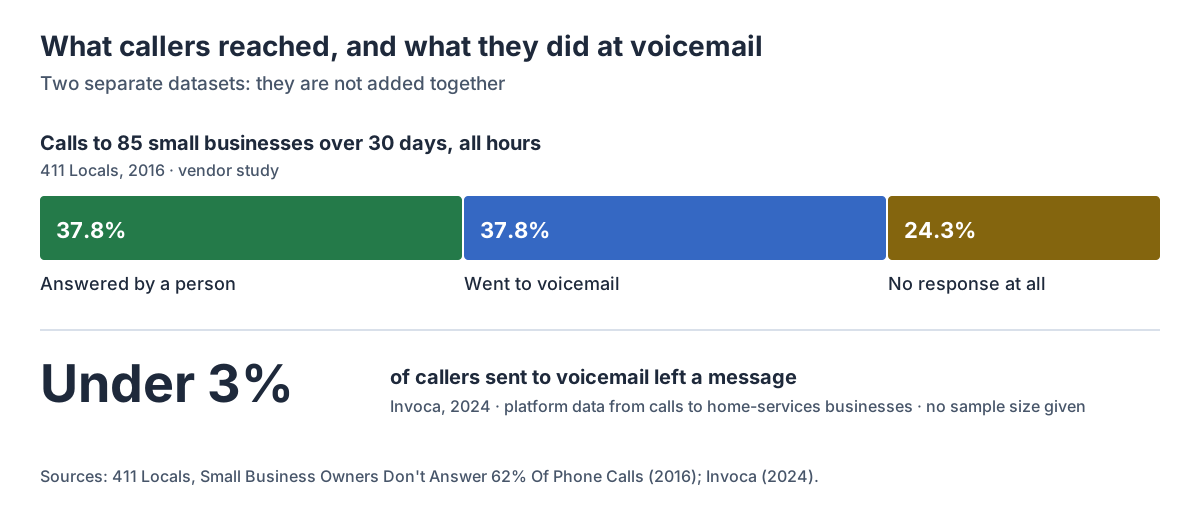
So the comparison at 9pm is not AI against a person. It is AI against a recording that, in Invoca’s home-services data, fewer than 3 in 100 callers spoke to. A caller who hangs up on the AI ends up where a voicemail caller would have: a missed number in your log, waiting for your callback. The callers who stay get an answer and a chance to book that night.
Hang-ups aren’t new with AI, either. In Patient Prism’s analysis of more than 11.5 million patient calls to 8,280 dental practice locations in 2025, 31 of every 100 callers hung up before reaching an agent. Patient Prism sells call analytics to dental practices; its page doesn’t break the figure down by cause, and it doesn’t measure AI answering.
Try it. Talk to the voice demonstration for two minutes and judge for yourself whether your callers would stay on the line. The business and calendar in the demo are simulated; the conversation is live.
Why do callers hang up on an AI?
The complaints are specific, and each one can be addressed in the setup:
- Being fooled. One reply in the r/sales thread: “They even included fake keyboard noises?? Why??” Five9’s survey found 71% of consumers consider it very or extremely important to know when they are interacting with an AI agent.
- No way to a person. Two-thirds of Five9’s respondents preferred a person. An AI with no route to one leaves those callers nowhere to go but the hang-up button.
- Repeating themselves. In the same survey, 83% said they still have to repeat themselves at least sometimes after being transferred. A handoff that drops the conversation is its own frustration.
- Wrong or useless answers. An AI that can’t say whether you cover their area, or gets your hours wrong, gives the caller a reason to go.
How do you keep callers on the line?
Start where the alternative is weakest, say what the voice is, and give every caller a way out to a person or a callback.
A measured approach
- Measure the baseline. Count after-hours calls and how many left a message (quick win 2). That is what you are trying to beat.
- Start after hours only. During the day a caller may still reach you; at night the alternative is voicemail. Put the AI where it competes with voicemail first.
- Open honestly. The greeting says it is an automated assistant and what it can do. No fake typing, no invented name pretending to be staff.
- Offer the way out in the first breath. “If you’d rather speak to someone, say so and I’ll get you a callback time.”
- Send urgent calls to a person, with what the caller already said attached, so nobody repeats themselves.
- Call back every hang-up first thing next morning, exactly as you would a missed call.
- Review twenty calls a week for the first month. Fix the answers that made people leave. Widen to daytime overflow only once after-hours calls are going well.
A greeting you can adapt
“Thanks for calling [business]. I’m the automated assistant, and I can answer questions about our services or book you a time. If you’d rather talk to someone from the team, just say so and I’ll arrange a callback. What can I help with?”
When should a person take the call instead?
| Situation | Who should answer | Why |
|---|---|---|
| Routine inquiry, after hours | AI receptionist | Beats voicemail; can book |
| Emergency, after hours | AI, then on-call person | Fast handoff with details |
| Upset existing customer | A person | Needs judgment |
| Open hours, you’re free | You | You know the work |
| Open hours, you’re on a job | AI as overflow | Answers instead of ringing out |
| Caller asks for a person | A person, or a set callback | Their choice, respected |
Worked example: a high hang-up rate
Example, not a statistic. Every input is an assumption. Swap in your own.
- 20 inquiries call after hours in a month.
- With voicemail, 2 leave a message. The other 18 are numbers in your call log.
- With an AI receptionist, suppose 8 of the 20 hang up as soon as they hear it. 12 talk to it.
| After-hours setup | Answered that night | Callbacks next morning |
|---|---|---|
| Voicemail | 0 (2 messages) | 20 |
| AI receptionist | 12 | 8 |
Even with 8 of 20 hanging up, the AI leaves you fewer callbacks than voicemail did, and 12 inquiries got an answer and a chance to book that night. The 8 who hung up are the same kind of entry in your call log a voicemail caller would have been. For the effect on booked jobs and on cost, see the worked example in How much does an AI receptionist or answering service cost?
Numbers we left out
- A 2024 Gartner survey on customers preferring companies not use AI for service. It supports the objection, but Gartner’s page blocked our attempts to check it, so we used Five9’s 2026 survey instead.
- AI receptionist “resolution rates” of 85–95%. Vendor figures with no independent benchmark behind them; we trace one in What your AI receptionist needs to know.
Where this breaks down
- Nobody has published an independent hang-up rate for AI receptionists that we could find. Yours is the number that matters, so measure it in the first month.
- Some callers will think less of you. The r/smallbusiness comment above is a real reaction. A caller who would have left a voicemail might hang up on the AI and not pick up your callback. We don’t know how often, and we found no published figure.
- Daytime is different. During open hours a caller may reach you or your team. An AI there should be overflow, not a wall in front of you.
- Bad answers can do more harm than silence. An AI that gives a wrong price or area can cost you more than voicemail would. Review the calls.
How Leadio does it
Leadio’s 24/7 Answering Service is an AI receptionist, run for you as a managed service. Before it goes live, you agree what it answers, books and escalates; we test real call paths with your team. It answers calls around the clock, or only after hours if you’d rather, asks your qualifying questions, and can book suitable inquiries where your calendar is connected. Urgent or complex matters go to the people you nominate, with the conversation attached. Our team reviews the conversations and corrects the answers when a gap shows up.
Following up callers who don’t book, or who hang up, is what the Lead Nurture Ladder is for, as a separate service.
Try it at the voice demonstration, then see what it would look like for your business.
FAQ
Is an AI receptionist a good idea for a small business? For routine inquiries that arrive when nobody can answer, it can be, as long as it says what it is, hands urgent calls to a person and reports hang-ups for callbacks. For delicate calls, a person is the better fit.
Should an AI receptionist say it’s AI? Yes. In Five9’s 2026 survey, 71% of consumers said knowing when they’re talking to an AI agent is very or extremely important.
What happens to callers who hang up on the AI? They show up in your call log with a number, unless they withheld it. Treat them as missed calls and call them back.
Can callers ask for a real person? They should be able to. Ask any provider how that works after hours, and whether the person gets the conversation so far.
24/7 Answering Service
Calls answered around the clock, including after hours, at lunch and when the line is busy. You can limit it to after hours or overflow.
More from turn leads into customers.
AI receptionist vs answering service: what each answers, what each books, and what callers hear
An AI receptionist and a live answering service both pick up the phone. Compare them by what gets answered, what gets booked and who does the work after the call, and start with the hours you actually miss.
How much does an AI receptionist or answering service cost? Compare it by cost per booked job
Ruby’s live receptionists bill by the minute, Smith.ai’s AI receptionist by the call, and a receptionist on staff by salary. None of those tells you what a booked job costs. Here is how to work that out with your own numbers.
When to ask for a Google review, and what to say
When customers say they will leave a review and then forget, remove the steps in between. Ask at the moment the job is finished, put the link in their hand within the hour, send one reminder, and stop. Scripts for in person, text and email included.
See where your leads are leaking.
Find out which stages are leaking, who we'd staff to plug them, and which Growth Team follows.