
AI receptionist vs answering service: what each answers, what each books, and what callers hear
An AI receptionist and a live answering service both pick up the phone. Compare them by what gets answered, what gets booked and who does the work after the call, and start with the hours you actually miss.

The short answer. A basic answering service puts a person on the line to take a message you return later. An AI receptionist answers any call it covers and, connected to your calendar, can book the job before the caller hangs up. Either way, picking up is not the same as booking. In Invoca’s 2026 home-services benchmark, vendor platform data from its own customers’ calls, 55% of the businesses didn’t ask leads to buy or book the job.
Who this is for. You sell through an inquiry: someone calls, texts or fills in a form, and the sale depends on getting them to an appointment, an estimate or a visit. You or your team can’t always pick up, because you are on a job, with a customer, or closed for the night.
What is the difference between an AI receptionist and an answering service?
An answering service is a team of people who answer your calls from their own office. An AI receptionist is software that answers in a synthetic voice, and works from the information you give it. The labels overlap, so ask any provider what it does with a call, not what it calls itself.
Even within live services there are two jobs. Ruby, which sells live receptionists, describes basic answering services as “mainly restricted to taking messages and doing a bit of basic call routing”, and lists appointment scheduling under its virtual receptionist service. So there are really four things you can put on your phone when you can’t answer:
- Voicemail, and you call back later.
- A message-taking answering service: a person picks up, writes down the details and sends them to you.
- A live virtual receptionist: a person picks up and can book into your calendar, if the provider has access to it.
- An AI receptionist: software picks up, answers from your approved information, asks your qualifying questions and books into your calendar.
Won’t callers hang up on an AI receptionist?
Some will. The useful question is what those callers would have reached instead. If nobody covers your phone after hours, the alternative is voicemail or nothing, not a person. Some people hanging up on an AI at 9pm is still better than nobody answering at 9pm, because the ones who stay get an answer and a chance to book.
That holds when the AI says what it is, hands urgent callers to a person, and every hang-up still gets a callback. We cover the objection in full, with what callers actually say and what they reach instead, in Do callers hang up on an AI receptionist?
Try it. Talk to the voice demonstration for two minutes and decide for yourself whether your callers would stay on the line. The business and calendar in the demo are simulated; the conversation is live.
Which one actually books the appointment?
Only the options with calendar access can book while the caller is on the line: a live virtual receptionist that has it, or an AI receptionist that is connected to it. A message-taking service and voicemail both end with a callback, and you have to reach the caller a second time.
Answering is not the same as booking, even when a person picks up. Invoca’s 2026 benchmark draws on calls tracked across its home-services customers. It found that 55% of those businesses didn’t ask leads to buy or book the job, and 45% of the leads who reached a person converted on the call. The figures are averages across Invoca’s customers; the report doesn’t say how many home-services calls it covers. Whoever answers your phone, ask whether it asks for the booking every time, and whether you can check that it did.
Do you need an answering service all day?
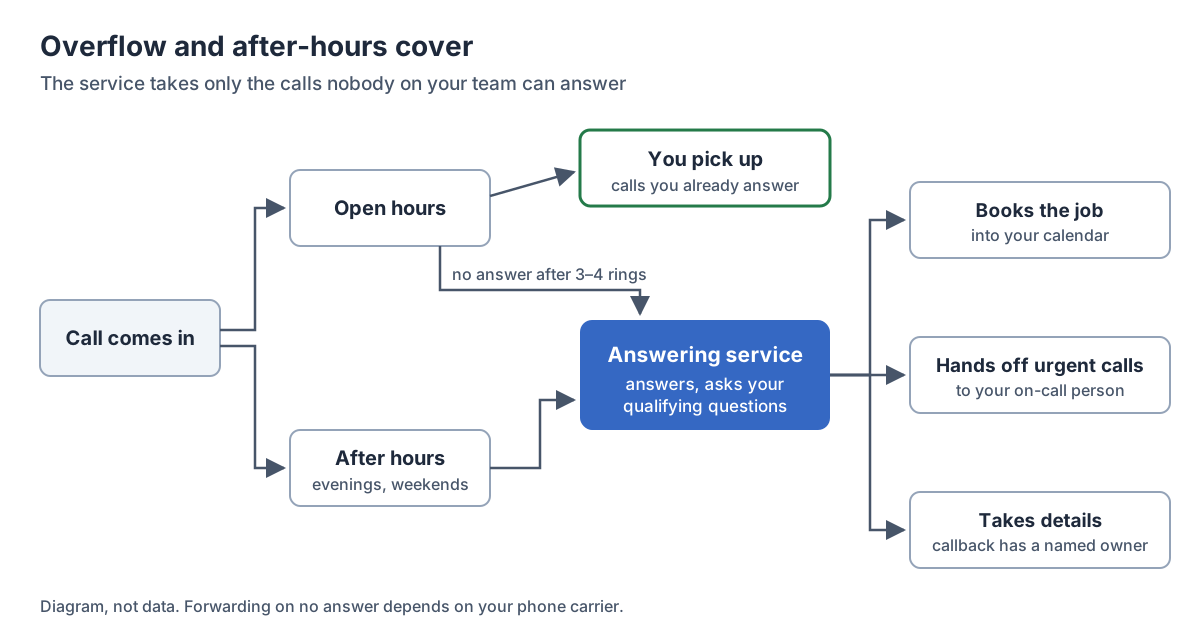
Not necessarily, and your own call log will tell you. If the calls you miss are mostly the ones that arrive while you are on a job or on another call, and the ones that arrive after closing, a service can cover only those. You keep the calls you already answer, and the service handles the rest.
A measured approach: cover the gaps first
- Measure. Count a month of missed calls, split into open hours and after hours (quick win 2). If the after-hours number is small and your callbacks reach people, fix the voicemail and callback first and stop there.
- Give callbacks an owner. One named person returns missed calls by a set time each morning. Without that, any answering option ends in a message nobody returns.
- Cover after hours. If nobody is at the phone in the evenings and at weekends, start there.
- Add overflow during the day. Forward-on-no-answer (quick win 4) sends only the calls you can’t take to the service.
- Go all day only if the numbers say so. If you miss most calls even during open hours, full-time cover makes sense, and so might a person on staff for the hours they work.
How do an AI receptionist, an answering service and an in-house receptionist compare?
They differ less in whether a call gets picked up than in whether it ends with a booking, and in who does the work afterwards.
| Option | Answers | Books on the call? | Work after the call |
|---|---|---|---|
| Voicemail | Nobody live | No | You call back |
| In-house receptionist | Their working hours | Yes | Theirs in hours; yours after |
| Message-taking service | Hours you buy | No | You call back |
| Live virtual receptionist | Hours you buy | If given your calendar | Theirs; you take exceptions |
| AI receptionist, self-set-up | Any hour | If you connect it | You maintain and check it |
| Managed AI answering service | Hours you agree | Where your calendar is connected | Provider maintains; you get handoffs |
A receptionist on staff is a strong option while they are at the desk. They cover their working hours: a 40-hour week, for example, is 40 of the 168 hours in a week. The other options are mostly about the remaining 128. What each costs, compared by booked job rather than monthly price, is in How much does an AI receptionist or answering service cost?
To a caller, the last two rows can sound the same. The difference is who notices when the AI gives a wrong answer, and who updates it when your prices or hours change. Leadio’s 24/7 Answering Service is the last row.
When is a live answering service the better choice?
When the calls are delicate or unpredictable: a distressed caller, a dispute, a medical or legal question, or anything where the right answer depends on judgment your script can’t cover. An AI receptionist suits calls that are mostly routine: what do you do, do you cover my area, when can you come, how do I book.
You can also use both. The AI answers the calls it covers and books the routine ones, and a person takes the handoffs.
Worked example: overflow and after-hours cover
Example, not a statistic. Every input is an assumption. Swap in your own from quick win 2.
- 120 calls a month.
- 80 arrive during open hours. You answer 60 and miss 20 because you are on a job.
- 40 arrive in the evening or at the weekend.
| Setup | Calls the service handles | Calls you still take |
|---|---|---|
| All-day answering | 120 | 0 |
| Overflow plus after hours | 60 | 60 |
| After hours only | 40 | 60, and 20 missed |
Overflow plus after hours covers every call nobody would have answered, while the half you already handle still reach you. After hours only is the smallest step, and it leaves the 20 daytime misses on your callback list. Whichever you pick, look at what happened to the calls the service took: how many booked, how many went to a person, and how many still need a callback.
Numbers we left out
These figures turn up in articles on this topic. We traced them and didn’t use them.
- “85% of callers who don’t get an answer won’t call back.” The oldest source we found is a 2016 Aircall blog post that states it with no study or citation.
- “80% of callers won’t leave a voicemail.” We found no study behind it. Invoca’s measured figure for callers sent to voicemail is in the hang-up article.
- “45% of leads arrive after hours.” The versions we traced led to one vendor’s internal data or to no source. Count your own after-hours calls instead.
Where this breaks down
- Your call log is the evidence. The comparisons above describe what each option does, not how your callers will react. Measure a month before and a month after.
- An AI is only as right as its information. If it quotes an old price or the wrong service area, it can do more harm than voicemail. Someone has to review the conversations and correct the answers.
- Booking isn’t the finish line. An appointment still needs a confirmation, a reminder and someone who follows up when the caller goes quiet.
- The benchmark data is from vendors. The Invoca figures come from its home-services customers’ calls. Your numbers may differ.
How Leadio does it
Leadio’s 24/7 Answering Service is an AI receptionist, run for you as a managed service. It answers calls around the clock by default, or only after hours and the calls you can’t take if you’d rather, using answers built from your services, hours, area and fit questions. It asks your qualifying questions and can book suitable inquiries where your calendar is connected. Urgent or complex matters go to the people you nominate, with the conversation attached, and every call lands in the Universal Inbox with an owner. Website chat, texts and social messages are answered by 24/7 Chat & DMs, from the same inbox. Our team reviews the conversations and corrects the answers when a gap shows up, so you are not the one maintaining it.
Inquiries that don’t book on the first contact, and open quotes after them, are the job of the Lead Nurture Ladder.
Try it at the voice demonstration. Then read how the 24/7 Answering Service works, and when you’re ready, see what it would look like for your business.
FAQ
Is an AI receptionist better than an answering service? It depends on your calls. For routine inquiries that should end in a booking, an AI receptionist can answer and book on the call. For delicate calls that need judgment, a person is the better fit. You can use the AI for the calls it covers and hand the difficult ones to a person.
Can an answering service cover only after hours? Yes, if the provider offers it. Ask for after-hours cover plus overflow (the calls you don’t pick up during the day), and check how your phone forwards unanswered calls.
Is a virtual receptionist the same as an AI receptionist? Not always. Ruby, for example, uses “virtual receptionist” for its live receptionists, while “AI receptionist” means software. Ask who, or what, picks up.
Can an AI receptionist book appointments? Yes, when it is connected to your calendar and you have agreed what it may book. Without that connection it can only take details.
Should an AI receptionist tell callers it is AI? We think so, for the reasons in Do callers hang up on an AI receptionist? Ask any provider whether you approve the greeting before it goes live. Anyone who asks for a person should be able to reach one or get a callback time.
24/7 Answering Service
Calls answered around the clock, including after hours, at lunch and when the line is busy. You can limit it to after hours or overflow.
More from turn leads into customers.
Do callers hang up on an AI receptionist? Some do, and here is why it still beats voicemail after hours
Some callers hang up the moment they hear an AI. If nobody covers your phone after hours, the alternative is voicemail, and in Invoca’s home-services call data fewer than 3% of callers sent there left a message. How to set up an AI receptionist so the callers who stay get an answer and the ones who hang up still get a callback.
How much does an AI receptionist or answering service cost? Compare it by cost per booked job
Ruby’s live receptionists bill by the minute, Smith.ai’s AI receptionist by the call, and a receptionist on staff by salary. None of those tells you what a booked job costs. Here is how to work that out with your own numbers.
When to ask for a Google review, and what to say
When customers say they will leave a review and then forget, remove the steps in between. Ask at the moment the job is finished, put the link in their hand within the hour, send one reminder, and stop. Scripts for in person, text and email included.
See where your leads are leaking.
Find out which stages are leaking, who we'd staff to plug them, and which Growth Team follows.