
Can an AI clone of you post for your business, and should it?
An AI clone built from your voice and likeness can deliver videos you never filmed. Whether it helps or costs you trust comes down to consent, disclosure and what you use it for. What the research says, how the capture session works, and when not to use one.
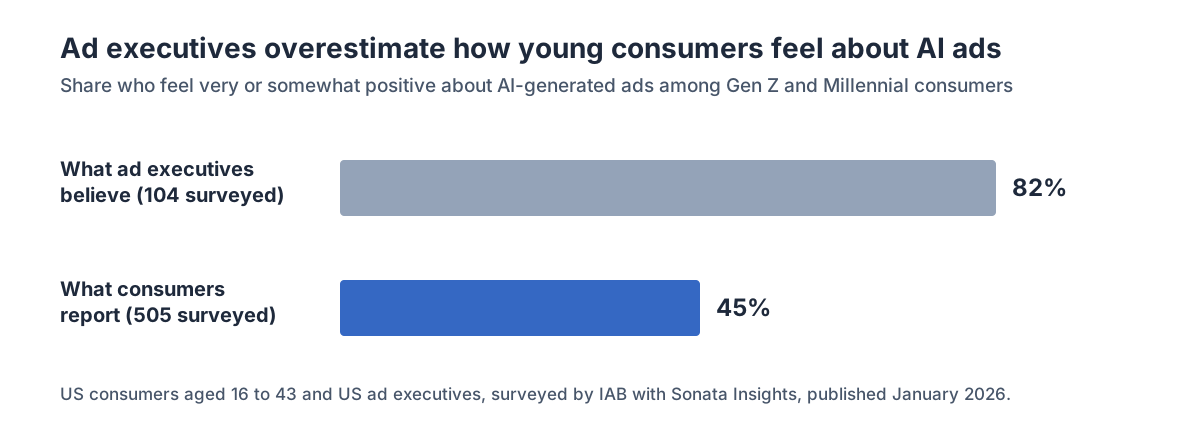
The short answer. Yes, an AI clone of you can post for your business: a voice clone and video avatar, built from a recording of you, delivering scripts you approve. Whether you should comes down to three things: you consented and own it, every video says it was made with AI, and you keep the real you for the moments that need it. Use it with care: in IAB’s 2026 survey, ad executives expected young consumers to like AI-generated ads far more than they did. 82% of executives thought they felt positive; 45% of those consumers did.
Who this is for. Your customers buy because they trust you, and the sale starts with a call, a consultation or an estimate. People look you up before they get in touch. You know video would help, and you rarely film it.
What is an AI clone, and how is it made?
It’s a voice model and a video avatar trained on footage of you, so a script you didn’t film can be delivered in your voice and likeness. In our experience, what you record in the capture session matters as much as the software.
A useful capture session is not “read this script.” It records:
- Range. Certainty, doubt, a laugh, a hard truth, a casual aside. A clone trained only on your presenter voice sounds like your presenter voice every time.
- Your own words. The phrases you use with customers, the names of your services, how you ask qualifying questions, the jargon you translate.
- Your face doing normal things. Natural pauses, glances, how you move when you explain something. That’s what makes it look like you, not a news anchor wearing your face.
- The ideas. A conversation about your work, your opinions and what customers get wrong. A clone delivers words; someone still has to know what you’d say.
Before anything is recorded, there should be a written agreement covering who owns the result, what it may be used for, and how it is deleted.
Won’t it look fake and cost me trust?
It can. The evidence below suggests a label costs little, and the researcher behind one avatar study says being found out is what hurts. One commenter on r/smallbusiness wrote that their posts got “exponentially” more traction “this year when I added my ugly mug to the posts.”
The IAB research shows the risk. Its survey, run with Sonata Insights, asked 505 US consumers aged 16 to 43 and 104 US ad executives about AI-generated ads. Ad executives expected far more goodwill than consumers reported, and Gen Z respondents were more negative than Millennials: 39% felt very or somewhat negative, against 20%. But the same survey found 73% of consumers said knowing an ad was made with AI would either increase or make no difference to their likelihood to buy.
Studies of avatars and AI labels add to the picture:
- People absorbed the avatar about as well as the real person. In a 2025 study by Jill Schiefelbein and colleagues at the University of South Florida, an online experiment with 290 participants found no statistically significant difference in information retention, engagement or trust between a video delivered by a real person and one delivered by their hyper-realistic avatar.
- The researcher’s view: finding out later is what hurts. Talking about that research to Bay News 9, Schiefelbein said: “When you don’t disclose and someone finds out, they feel fooled. They feel deceived. They feel swindled.”
- A label didn’t hurt recall. In a MediaScience test of AI disclosure labels on video ads with 900 US participants, reported by Marketing Dive in June 2026, unaided brand recall was 54% with no label and between 54% and 61% across the four label styles tested.
On this evidence, a label costs little. A labelled clone, saying things you’d say, is a different proposition from one passed off as you.
Do I have to tell people it’s an AI clone?
On YouTube and Meta, for realistic content, yes, and you should anyway. YouTube’s disclosure rules require creators to disclose AI content that “makes a real person appear to say or do something they didn’t do.” The same page lists “cloning one’s own voice to create voice overs or dubs” as a minor edit that doesn’t need disclosure. A full video avatar delivering a new script is much closer to the first case, so tick “AI use.”
Meta said in 2024 that it requires people to use its disclosure tool “when they post organic content with a photorealistic video or realistic-sounding audio that was digitally created or altered,” and may penalise those who don’t.
Beyond the platform label, say it in your own words too: on screen at the start, or in the caption.
Who owns my clone, and what can be done with it?
Largely, whatever the agreement says. That’s why the agreement comes before the recording. Settle these in writing:
- Ownership. Your voice and likeness stay yours. The provider gets a licence to make what you approve, nothing more.
- Use. Which channels, which kinds of content, and whether ads are included.
- Approval. Nothing is published without your yes on the script.
- Deletion. How you ask, how fast it happens, and confirmation that it’s done, including when you stop.
- Other people. Never clone a staff member without their own written consent, and decide what happens when they leave.
When shouldn’t I use a clone?
When the moment needs the real you, or when you’d be embarrassed if a customer found out how it was made.
- Apologies, condolences and anything personal. If the absence of the real you would feel like a betrayal, film it yourself.
- Live or reactive moments. Replies to a comment thread, a local news event, a complaint. A clone can’t hold a conversation in public.
- Pretending you were there. Don’t use an avatar to imply you were on a job, at an event or with a customer when you weren’t.
- Claims you haven’t checked. Prices, guarantees, results. A wrong figure in your face and voice is still yours.
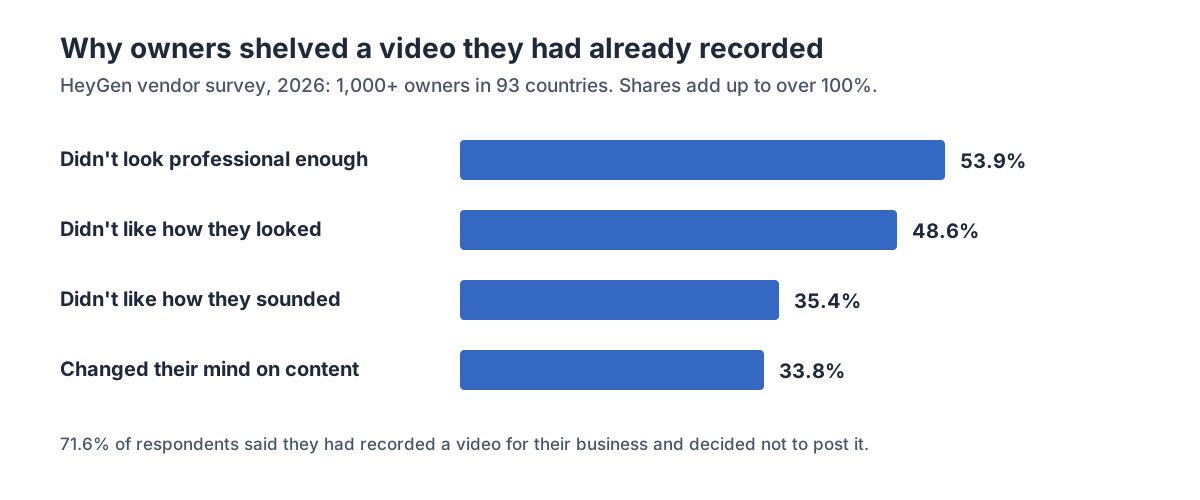
- If you hate it. If the clone doesn’t look or sound like you, don’t publish it. In HeyGen’s 2026 vendor survey, the reason owners most often gave for shelving a video they’d recorded themselves was that it “didn’t look professional enough.” A clone that also doesn’t look right fixes nothing.
How do I start, smallest step first?
Start with the real you and add the clone only where it saves time you don’t have.
- Phone video, once a week. One question from your list, one take. If you can keep this up, you may not need a clone at all.
- Batch it. Record four answers in one sitting once a month. Same real you, a quarter of the setup.
- Use a voice clone for the edges. Voiceovers, dubs into a language some customers prefer, short audio fixes. YouTube treats cloning your own voice for voiceovers or dubs as a minor edit.
- Add a disclosed avatar for the volume layer. Evergreen answers, explainers, weekly tips. Keep filming yourself for the personal moments.
- Hand off the production. If writing, producing and posting is what stops you, have someone else do it, with you approving every script.
When to go further: when you’ve proved weekly video is worth it (people mention your videos on calls, or ask the questions you answered) but you can’t keep filming.
Which option fits?
| Option | Your time each week | Label it? | Who writes and edits |
|---|---|---|---|
| Film yourself weekly | Set-up, filming, editing | No | You |
| Monthly batch shoot | One session a month | No | You, or an editor |
| DIY avatar tool | Writing and checking | Yes | You |
| Done-for-you clone service | Approving scripts | Yes | The provider; you approve |
| No video | None | No | Nobody |
What does it save me?
Worked example (example, not a statistic). Every input is an assumption. Use your own.
- You want one short video a week, and a month has four filming weeks.
- Filming it yourself takes 3 hours: script, set-up, takes and editing.
- With a clone service, you spend 30 minutes a week reading and approving scripts, plus a 2-hour capture session once.
| Film yourself | Clone service | |
|---|---|---|
| First month | 12 hours | 4 hours |
| Each month after | 12 hours | 2 hours |
| First year | 144 hours | 26 hours |
Price those hours at what your time is worth and compare them with the service fee. Then ask the harder question: would you actually keep filming for 144 hours?
Numbers we left out
- “Three seconds of audio is all it takes to clone a voice.” An earlier version of this page said buyers could tell a flat clone “inside three seconds.” We found no source for either. How long a recording you need depends on the tool and on how good you want it to be.
- “68% of people trust brands less when content is fully AI-generated and undisclosed.” Often credited to Sprout Social; we couldn’t find it in Sprout’s publications.
- Yahoo and Publicis figures on how much disclosure lifts trust. We saw them only in second-hand coverage, so we left them out.
Where this breaks down
- The IAB survey is about AI ads in general, among consumers aged 16 to 43, not about owners cloning themselves.
- The same avatar study found a significant difference in information retention between the avatar video with disclosure and without it. The abstract doesn’t make the direction plain, so we don’t lean on it either way.
- The avatar study was an online experiment with 290 participants in a business-to-business setting, and the disclosure quote comes from a news interview, not a published table.
- The label study is second-hand. We read MediaScience’s results in Marketing Dive’s coverage; we couldn’t access the full report.
- HeyGen sells avatars. Its survey is useful on why owners shelve videos, but read it as a vendor’s research.
- Rules are moving. A New York law requiring ads to disclose “synthetic performers” (digitally created humans, including AI-made ones) was set to take effect on 9 June 2026, according to law firm Cooley’s summary. It covers digital humans who aren’t a real, identifiable person, so it shows how specific these rules are. If your clone will appear in paid ads, have the rules where you advertise checked.
- A clone can’t be there. It can’t reply to comments, meet a customer or react to the week’s news. Someone still has to.
How Leadio does it
Leadio’s Social Media Management is a managed content program: strategy, a monthly calendar, short-form video, carousels and posts made from your real work, approved by you and published for you. It doesn’t publish synthetic people or voices presented as your team.
If you want a labelled clone of yourself, so you’re on camera every week without a weekly shoot, that’s Content Clone. One guided recording session, with a written consent agreement signed before anything is built. From it we build a voice clone and video avatar, checked against your real footage. Each week we write scripts from your ideas, you approve, edit or reject every one, and each video is labelled as made with your digital likeness. You own your likeness, and we delete the clone when you ask. See what Content Clone involves, or read more about Social Media Management.
FAQ
Is it legal to make an AI clone of myself for business videos? Cloning yourself with your own consent is the simplest case. The questions to check include the provider’s terms, the platforms’ disclosure rules and any advertising rules where you run ads. Never clone anyone else without their written consent. This isn’t legal advice.
Do I have to disclose an AI avatar on YouTube or Instagram? YouTube requires disclosure when realistic AI content makes a real person appear to say something they didn’t. Meta said in 2024 that it requires its disclosure tool for photorealistic video or realistic-sounding audio that was digitally created or altered. Label it anyway.
Will customers know it’s not really me? They should, because you tell them. Schiefelbein, whose avatar study is above, says the damage comes from people finding out afterwards.
How long does the recording session take? It depends on the tool and the quality you want. Plan for a guided session that also covers your ideas, not just your voice and face.
Can my clone reply to comments or messages? It shouldn’t pretend to. Replies to comments and messages are a separate job, and they should come from a person or an assistant that says what it is.
Social Media Management
A managed content program: strategy, video, carousels and posts made from your real work, approved by you and published for you.
More from get found.
Are your Facebook leads junk, or just slow to reach?
Before you blame Meta for bots, check how fast your team called. Facebook lead forms are built for volume by default, and a lead reached the next day is a different lead. A three-question check, the form settings to change, and when to go further.
Google now charges for some missed LSA calls: what changed on 1 October 2026
Since 1 October 2026, a Local Services Ads call you miss during business hours can be charged as a lead if the caller stays on the line for more than 20 seconds. Here is the rule, what it costs you, and the smallest fixes.
LSAs are moving into Google Ads: what to do before your account migrates
Google is moving Local Services Ads into Google Ads as Performance Max campaigns with pay-per-lead goals. Your past reports will not come with you. Here is what changes, what stays, and a checklist for the 14 days before your date.
See where your leads are leaking.
Find out which stages are leaking, who we'd staff to plug them, and which Growth Team follows.