
Are your Facebook leads junk, or just slow to reach?
Before you blame Meta for bots, check how fast your team called. Facebook lead forms are built for volume by default, and a lead reached the next day is a different lead. A three-question check, the form settings to change, and when to go further.

The short answer. Some Facebook leads are junk, but you can’t tell which until you’ve called them quickly. Meta’s lead form documentation says forms are “optimized for the volume of leads” by default, so expect a mix. Speed is the part you control. In Harvard Business Review’s 2011 study of 1.25 million web leads at 42 US companies, firms that tried to contact a lead within an hour were more than 60 times as likely to qualify it as those that waited 24 hours or longer.
Who this is for. You run Facebook or Instagram lead ads, and your sale starts when someone fills in the form and you call them to book a visit, an estimate or an appointment. The leads arrive, but too few answer, and the ones who do don’t remember filling in anything.
Are Facebook leads fake?
Some may be low-intent or outright bad; Meta says forms are optimised for lead volume by default. Before you call a lead fake, check whether the first call was slow. A slow first call can’t tell you much. Start with your own timestamps before you change anything in Ads Manager.
The complaint is real. A poster on r/FacebookAds asked whether Meta is “just pushing bots at this point”, since leads were “even filling out multiple questions in the forms, (like 8+) but still are unresponsive to my team.” One reply: “depends how fast your team is reaching out to them. If they’re reaching out after 12 to 24hours then it’s expected to happen.”
Another poster on the same subreddit, running ads for a client, checked after the client complained about lead quality: “390 leads… Today i ask how many leads they have call? GUESSSSS 100 leads they call.” Those are two anecdotes, not data, but they show the question to ask first.
Why do Facebook leads not answer the phone?
There are plenty of reasons that have nothing to do with bots. An instant form is short and filled in without leaving the app, so the person who filled it in may be mid-scroll, at work, or comparing several businesses. HBR’s 2011 study of web leads (not Facebook leads) measured how the odds of qualifying a lead fall with delay. Firms that tried within an hour were more than 60 times as likely to qualify the lead (HBR defines that as a meaningful conversation with a key decision maker) as those that waited 24 hours or longer. Against firms that tried even an hour later, the first-hour firms were nearly seven times as likely to qualify the lead.
The Reddit reply’s “12 to 24hours” sits close to HBR’s slowest group, and a lead left a full day or more is in it.
How much am I paying for each lead?
It depends on your industry. LocaliQ and WordStream’s Facebook Advertising Benchmarks for 2026 (vendor data) put the average cost per lead for lead campaigns across industries at $27.39. For Home & Home Improvement it was $42.95. LocaliQ doesn’t state the sample size or period, so treat these as a rough guide and use your own Ads Manager figure.
At that kind of price, it’s worth knowing whether the lead or the wait is the problem before you spend more. It’s the first thing we check in Paid Advertising Management, before any budget changes.
How do I fix it, smallest change first?
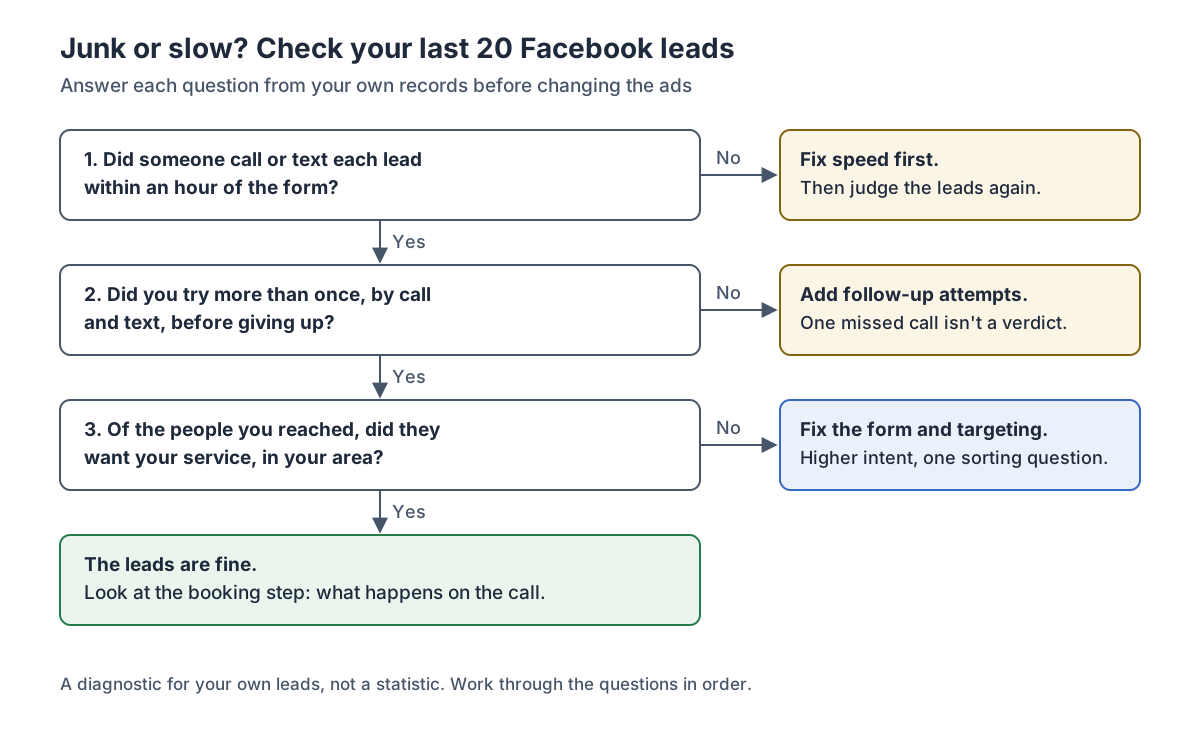
Fix the follow-up before the ads, because you can’t judge the ads while the follow-up is slow.
- Measure for two weeks. Use the quick-win log: time to first contact, reached or not, right fit or not, booked or not. Without it every other change is a guess.
- Reply within minutes, every time. An automatic text the moment the form arrives, then a call. If nobody can call during the day, decide who covers it, or run the ads only in the hours someone can.
- Try more than once. A no-answer on the first call isn’t a verdict. Plan several calls and texts over a few days, and stop when someone replies or opts out. We cover what the call-attempt research shows in The Empty Desks in Most Service Businesses.
- Then tighten the form. Turn on the higher-intent setting and add one sorting question. It may bring fewer leads, so judge it by booked jobs, not lead count.
- Then fix the targeting and offer. If the people you reach still don’t want what you sell, look at the audience, area and offer, not the form.
- Go further when you have volume. Meta’s Conversion Leads goal is designed to use outcomes from your customer records to find people more likely to convert. Meta’s guide to connecting your lead records says a business is a good fit if, among other guidelines, it uses Meta’s instant forms, generates at least 200 leads a month, can upload data at least once a day, and the stage it optimises for happens within 28 days of the lead. Below that, steps 1 to 5 matter more.
Which form setup should I use?
| Setup | What it changes | Who does the work |
|---|---|---|
| Default form | Optimised for lead volume | You sort them on the phone |
| Higher-intent setting | Adds a review-and-confirm step | Same, after a confirm step |
| Form plus one sorting question | Filters by area or timing | You set the question once |
| Landing page instead of a form | Visitor leaves the app to apply | You build and maintain the page |
| Conversion Leads with your sales data | Meta optimises for your outcomes | You send lead outcomes daily |
None of these replaces calling quickly. A better form gives you better leads to reach; it doesn’t reach them.
What could faster follow-up be worth?
Worked example (example, not a statistic). Every input is an assumption. Swap in your own from the two-week log.
- 100 Facebook leads a month at $40 each: $4,000.
- Today, your team calls the next day and reaches 1 in 5.
- With a text in minutes and a call within the hour, you reach 1 in 2.
- Of the people you reach, 1 in 4 books.
| Next-day call | Within the hour | |
|---|---|---|
| Leads reached | 20 | 50 |
| Booked jobs | 5 | 12.5 |
| Ad cost per booked job | $800 | $320 |
Same ads, same budget, same leads. The only change is how fast someone reached them. Your own reach rates may be higher or lower; the point is to measure both before deciding the leads are junk.
Numbers we left out
- “78% of customers buy from the company that responds first.” It’s credited to a “Lead Connect survey” with no published report that we, or Expertise.ai, could find. Expertise.ai’s stats page calls it folklore.
- “Lead response odds drop 80% after 5 minutes.” It’s attributed to a 2007 lead-response study, which doesn’t say it.
- “Higher-intent forms cut lead volume by 20 to 40%.” We traced it to a blog estimate, not Meta or a study.
Where this breaks down
- HBR’s data is from 2011 and not about Facebook. It covered web leads at 29 consumer and 13 business-to-business US companies. We’d expect the direction to apply to Facebook form leads too, but HBR didn’t measure them, and the multiples are theirs, not yours.
- Some leads really are bad. Speed won’t turn a wrong-area or no-budget lead into a job. That’s what step 4 and 5 are for.
- Benchmarks are vendor data. LocaliQ doesn’t publish its sample, and your market can differ a lot.
- Calling fast takes someone’s time. If nobody can, running the ads in fewer hours may cost less than paying for leads that wait.
How Leadio does it
Leadio’s Paid Advertising Management builds Meta campaigns, forms and landing pages as one path from ad to booked appointment. We test the handoff before budget runs, and we report spend, enquiries and booked next steps as far as your tracking can verify.
Follow-up is where the leads in this article go missing. The Lead Nurture Ladder keeps active enquiries moving across the channels you agree, with clear rules for when to stop. Our 24/7 Answering Service, an AI receptionist run for you, handles the calls that come back in, and 24/7 Chat & DMs answers the messages. Try it at the voice demonstration. Bring your offer, your area and what a booked job is worth, and we’ll look at whether paid ads make sense now.
FAQ
Why do my Facebook leads say they never filled out a form? Instant forms are quick to submit inside the app, so people may not remember one by the time you call, especially a day later. A text within minutes that names your business and what they asked about helps. The higher-intent setting adds a review step before they submit.
Should I use a landing page instead of an instant form? It asks more of the visitor, since they leave the app. Test it against a form with the higher-intent setting and compare booked jobs, not cost per lead.
How fast should I call a Facebook lead? Within the hour at most. In HBR’s 2011 study of web leads, firms that tried within an hour were more than 60 times as likely to qualify a lead as those that waited 24 hours or longer.
How many questions should my lead form have? As few as you need to sort the leads you can serve. Start with one that matters, such as area or timing, and add more only if your log shows a need.
What is a good cost per lead on Facebook? LocaliQ’s 2026 benchmarks put the all-industry average for lead campaigns at $27.39 and Home & Home Improvement at $42.95. The number that matters more is your cost per booked job.
Paid Advertising Management
Google Search, Local Services Ads and Meta campaigns, built as one path from ad to booked appointment.
More from get found.
Can an AI clone of you post for your business, and should it?
An AI clone built from your voice and likeness can deliver videos you never filmed. Whether it helps or costs you trust comes down to consent, disclosure and what you use it for. What the research says, how the capture session works, and when not to use one.
Google now charges for some missed LSA calls: what changed on 1 October 2026
Since 1 October 2026, a Local Services Ads call you miss during business hours can be charged as a lead if the caller stays on the line for more than 20 seconds. Here is the rule, what it costs you, and the smallest fixes.
LSAs are moving into Google Ads: what to do before your account migrates
Google is moving Local Services Ads into Google Ads as Performance Max campaigns with pay-per-lead goals. Your past reports will not come with you. Here is what changes, what stays, and a checklist for the 14 days before your date.
See where your leads are leaking.
Find out which stages are leaking, who we'd staff to plug them, and which Growth Team follows.