
Who owns your ad accounts? What to ask before you hire marketing help, and how to tell if it's working
An ownership checklist, the contract terms to read before you sign, and the number that shows whether marketing help is working: cost per booked job. Free to use with any agency, freelancer or provider.

The short answer. Your business should own every account that holds your marketing history: the domain, the Google Business Profile, the ad accounts, analytics, the phone numbers and the customer list. The provider should get access you can remove. Then judge the work by cost per booked job, not by leads or rankings. Fees and ad spend are separate costs. Hook Agency, which sells marketing to home-service businesses, puts a reasonable Google Ads management fee at “$500 to $2,500 per month” on top of ad spend (its 2026 cost guide; a vendor’s price view, not a survey).
Who this is for. You sell through an inquiry, an estimate or an appointment, and you pay, or are about to pay, someone else to bring in those inquiries: an agency, a freelancer, a software bundle with a service attached, or a managed provider. You want to know what you should own, what to check in the contract, and how you’ll know in three months whether it’s working.
Who should own my ad accounts, my agency or me?
You should. The accounts, and the history inside them, belong to your business; the agency should work inside them with access you can take away. If an agency builds your campaigns inside its own account, the campaign history, conversion data and audiences may stay with the agency when you leave.
One owner on r/smallbusiness, paying an agency $3,500 a month, wrote: “I feel like I’m held hostage because I don’t have access to everything.” A commenter replied: “They shouldn’t have set you up under their account to begin with…you own it, they get admin access” (thread). We’d go one step further: you hold the top role yourself, and the provider gets the level it needs to do the work.
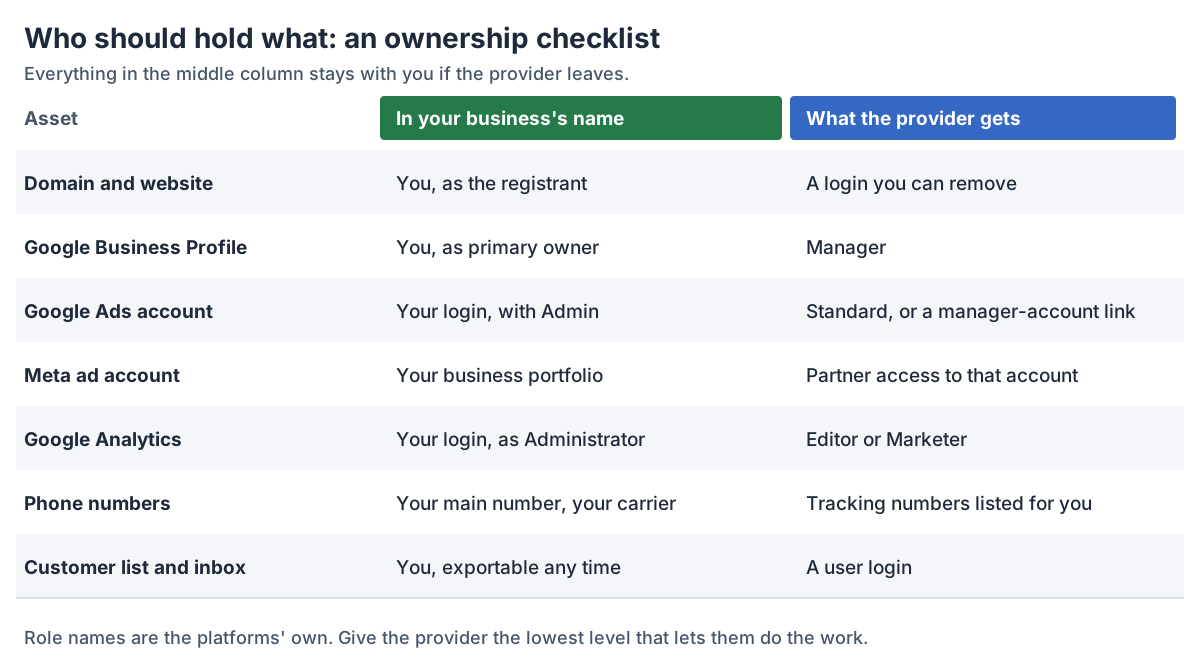
The platforms are built for this:
- Google Ads has five access levels: Email-only, Billing, Read-only, Standard and Admin. Only Admin can “give account access, change access levels”, and unlink manager accounts. Keep Admin on your own login.
- Google Business Profile can have “multiple owners but only one primary owner”, and managers “can’t add or remove users or remove the profile” (Google). You are the primary owner; the provider is a manager.
- Google Analytics gives the Administrator role the power to add and delete users (Google). Keep it.
- Meta lets you give a partner access to business assets in your business portfolio. Your portfolio owns the ad account; the agency is the partner.
”Marketing agencies are a scam. Why hire one at all?”
Some arrangements do go badly, and owners say so in plain words. An owner on r/AusLegalAdvice was told “he could get me minimum 10 jobs a week… 2nd week i got NO LEADS at all” (thread). A post on r/SaaS describes “a lot of reports explaining why things weren’t working yet. Always next month. Always one more optimization away” (thread).
The answer isn’t to trust nobody. It’s to set the arrangement up so trust matters less: you own the accounts, you can leave on known terms, and the report shows booked jobs. With those three in place, a provider who isn’t working costs you a notice period, not your history. And sometimes the honest answer is that you don’t need outside help yet. If inquiries already go unanswered, buying more of them won’t fix that; our leak scorecard helps you check first.
What should a marketing contract say before I sign?
It should say how long you’re committed, how you leave, what you keep, and what you’re paying for, with the fee shown separately from ad spend. Terms vary by provider and by service, so read them line by line.
For example, Scorpion’s own FAQ says it “typically requires a 12-month contract for our marketing technology and certain marketing services like search engine optimization (SEO)”, while “Digital advertising services like Google Ads, LSAs, Meta, etc. are typically month-to-month terms” (Scorpion). Neither is wrong in itself. What matters is that you know which you’re signing, and what happens at the end.
On fees, Hook Agency’s guide warns that “Some agencies roll them together into one number on a proposal without breaking it out” (Hook Agency). Ask for the management fee and the ad spend on separate lines, and ask who the ad platform bills.
How do I tell if my marketing agency is working?
Track the cost of each booked job, not the cost of each lead. Hook Agency’s guide puts it this way: cost per lead is not the key figure, “Cost per booked job is.” A cheap lead that never books is worth less than a dearer one that does.
Rankings can rise while the phone stays quiet. An agency posting on r/MarketingHelp described a home-services client who cancelled after “43 at #1, plus citations in AI overviews and chatgpt”, because “leads were flat for the whole engagement” (thread). The agency’s own post says the client was right.
Ask for a report with these lines, every month:
| Line | What it tells you |
|---|---|
| Spend (fee and ads, separately) | What you paid |
| Inquiries | What the marketing produced |
| Inquiries answered | Whether your side kept up |
| Booked jobs | What actually turned into work |
| Cost per booked job | The number to compare month to month |
If “inquiries answered” is low, the problem may be on your side, not the agency’s. That is worth knowing before you fire anyone.
What are my options for getting marketing done?
| Option | What gets done | What gets booked | Who does the work |
|---|---|---|---|
| Do it yourself | What fits around the jobs | Whatever you follow up | You |
| A freelancer | One skill, in depth | Tracked if you ask for it | The freelancer, plus you |
| An agency on retainer | Campaigns, SEO, content | Depends on the report you demand | The agency team |
| A software bundle | Tools, templates, automations | What the tools can book | You set it up and run it |
| A managed service | Marketing plus the follow-through | Tracked to booked jobs, if agreed | The provider, with your sign-off |
None of these is right for everyone. A freelancer who knows one platform can beat an agency on that platform. The questions below work for all of them.
How to fix it yourself, smallest step first
- Audit access (one hour). For every account in the checklist above, write down who owns it and who has access. Use the quick wins.
- Move ownership where it’s wrong. Ask the provider in writing to make your login the Admin or primary owner, or to move campaigns into an account in your name. A refusal is itself a red flag.
- Add a booked-jobs line to the report. If your own records can’t tell which jobs came from marketing, start by asking every new customer “how did you find us?” and noting it.
- Set a review date with a decision rule. For example: “At 90 days, if cost per booked job hasn’t improved, we change the plan or end the contract.”
- Then decide. Keep, change provider, or bring it in-house, with your accounts and history coming with you whichever you choose.
Which agency report is better? A worked example
Example, not a statistic. Every input below is an assumption. Swap in your own.
Two providers each spend $3,000 a month on ads for you, and each charges a $1,000 management fee.
| Provider A | Provider B | |
|---|---|---|
| Leads | 60 | 30 |
| Cost per lead (ads only) | $50 | $100 |
| Booked jobs | 6 | 12 |
| Cost per booked job (ads + fee) | about $667 | about $333 |
Provider A’s report looks better on leads. Provider B booked twice the work for the same money. If you only see cost per lead, you’d keep the wrong one. If B’s leads booked well because your team answered them fast, the credit is shared; that’s why the report needs the “inquiries answered” line too.
Numbers we left out
- “The SBA recommends spending 7–8% of revenue on marketing.” It is repeated online as SBA advice, but the SBA’s own budgeting page doesn’t recommend it. That page cites other publishers: 1.08% of revenue on advertising on average, and 7.9% on marketing in 2018, as reported averages, not advice.
- “$4–6k a month” for a Meta ads account manager. An earlier Leadio post used this figure with no source, and we’ve retired that post.
- “$1,500–$10,000+ a month” for Scorpion. This range comes from a competitor’s comparison page, which attributes it to client reports, says Scorpion doesn’t publish its pricing, and gives a different range ($3,000 to $10,000+) in its own introduction. We don’t quote it as Scorpion’s price.
Where this breaks down
- Ownership doesn’t guarantee results. You can own every account and still get poor campaigns. Ownership protects your exit; the report tells you whether to use it.
- Booked jobs need tracking on your side. If inquiries aren’t recorded, nobody can work out cost per booked job, including you.
- Some setups are legitimately the provider’s. Call-tracking numbers or landing-page tools may sit in a provider’s account. Ask for a written list of what they are and what happens to each when you leave.
- Platform menus change. The role names above come from Google’s and Meta’s help pages as of October 2026. Check the current page before you change access.
How Leadio does it
The Growth System is Leadio’s managed package for handling inquiries and customers. Its search, social and paid advertising services are optional, priced separately, and work inside accounts in your name. On Paid Advertising Management, the ad accounts are yours, ad spend is paid directly to the platforms and billed separately from our fee, and we report spend, inquiries and booked next steps as far as your tracking allows, saying where the trail is partial. We don’t promise a return on ad spend. Local SEO & AI Answers keeps your Business Profile in your name, and Social Media Management works through access you grant and can remove at any time. These marketing services have a three-month minimum, stated up front.
When your ads make the phone ring, the 24/7 Answering Service can answer it. Leadio’s 24/7 Answering Service is an AI receptionist, run for you, with handoffs to the people you nominate, and your proposal states what the AI handles and what your people handle. Try it at the voice demonstration before you decide.
To see whether more marketing is the right next step for you at all, start with Find Your Leaks.
FAQ
Is a marketing agency worth it for a small business? It can be, when you own the accounts, the contract has a clear exit, and the report shows booked jobs. If your inquiries already go unanswered, fix that first; more leads won’t fix that.
What if my agency won’t give me access to my ad account? Ask in writing for Admin access or for the campaigns to be moved to an account in your name. If the account is the agency’s, ask what you can export: campaign settings, conversion data and reports.
What should be in a monthly marketing report? Spend (fee and ads separately), inquiries, inquiries answered, booked jobs and cost per booked job, plus what changed this month and why.
How long should a marketing contract be? It depends on the work and the provider. Some set longer minimums for search work than for ads; Scorpion, above, is one example. Whatever the term, know the notice period and what you keep at the end.
How do I know if my agency is legit? Check that your accounts are in your name, the fee is separate from ad spend, no ranking or job count is guaranteed, and they’ll talk about booked jobs, not just clicks.
More from growth system field notes.
Where are your leads leaking? A scorecard for businesses that sell by inquiry, estimate or appointment
A free scorecard you can run on your own business in about an hour: one test for each leak in a six-stage frame, from the first review a buyer reads to the customer who never hears from you again.
The Empty Desks in Most Service Businesses
Walk the floor of your business as if every growth responsibility had a desk. The empty ones explain more lost revenue than anything your competitors are doing.
What Is a Growth System? The full service menu, and the order to fix things in
A Growth System is the set of jobs that turn attention into booked, kept customers, run as one thing. Here is the full menu, which services to fix first and why, and a way to map your own business for free.
See where your leads are leaking.
Find out which stages are leaking, who we'd staff to plug them, and which Growth Team follows.