
Why does a competitor with worse reviews outrank you on Google Maps?
Stars are one input among several. Google ranks the map mainly on relevance, distance and prominence, and experts rate category, proximity and the business name above star rating. What to check, what to fix first, and how to report a competitor who is breaking the rules.

The short answer. Because the map isn’t ranked by stars alone. Google says local results are based mainly on relevance, distance and popularity (the same page also calls the third one prominence), so a competitor can win by being closer to the person searching, by choosing a better-matched category, or by getting reviews more steadily than you. In Whitespark’s Local Search Ranking Factors 2026, a survey of 47 local search experts published in November 2025, a high star rating came sixth for the map; primary category, proximity to the searcher and keywords in the business name came first, second and third.
Who this is for. People find you by searching for a service near them. You’ve built a good reputation, and a competitor with a lower rating, fewer reviews or a worse service shows above you on Google Maps. You want to know why, what you can change, and what to do if they’re cheating.
Why does a competitor with worse reviews outrank me?
Because reviews are only part of one of the three things Google looks at. A competitor who is closer to the searcher, in a better-matched category, or getting reviews more recently can rank above a business with a higher rating.
It’s a frustrating thing to see. An owner on r/GoogleMyBusiness wrote: “My shop has always had a strong 4.8 stars… But recently one of my friends showed me that the chain is now number 1! Even though they have less reviews and a lower score at 4.3. I just don’t get it.”
Without seeing the listings, we can’t say which factor decided that one. But notice how the owner found out: a friend searched. Where that friend was standing, and what they typed, may have mattered as much as the stars.
”But my reviews are better.” Don’t reviews count?
They do count; they’re just not the only thing that counts, and how many recent reviews may matter more than your total count. Google’s help page on local ranking says “More reviews and positive ratings can help your business’s local ranking”, as part of prominence.
Two sources, and they don’t fully agree. Whitespark’s experts still rank star rating above review count and recency; Sterling Sky’s data points to recency over total count:
- In Whitespark’s survey (Whitespark sells local SEO software and services), “High Numerical Google Ratings (e.g. 4-5)” came sixth and “Quantity of Native Google Reviews (w/text)” ninth. “Recency of Reviews” was eleventh and “Sustained Influx of Reviews Over Time (rather than bursts)” fourteenth, out of 187 factors. These are experts’ ratings, not measurements.
- Sterling Sky, a local SEO agency, and Places Scout analysed 8,186 businesses in 200 cities in 2025, looking at the top 10 map results for five “near me” searches (plumber, HVAC, locksmith, garage door repair and lawn care). Their conclusion: “The number of reviews you’ve gotten this month matters more than your total number of reviews.” They also report a dental client that had been getting more than 60 reviews a month, received none for 18 days, and whose rankings “fell off a cliff.” That is one client and a correlational study, not proof of cause.
So a 4.8 earned years ago, with nothing new this month, can lose ground to a 4.3 that gets a few reviews every week.
What does Google say decides who ranks on the map?
Google’s help page says local results are “mainly based on relevance, distance, and popularity”, and it defines three factors:
- Relevance: “how well a Business Profile matches what someone is searching for.” Google says to provide “complete and detailed business info”; in our reading, that includes your category and services.
- Distance: “how far each business is from the customer who’s searching.” You can’t change where your customer is.
- Prominence: “how well-known a business is”, based on “info like how many websites link to your business and how many reviews you have.”
It also says: “There’s no way to request or pay for a better local ranking on Google.”
What do local SEO experts rate highest?
Category, proximity and the business name, then location and hours, with reviews close behind. Whitespark asks experts to score how much each factor affects the map; the top ten for 2026 are below.
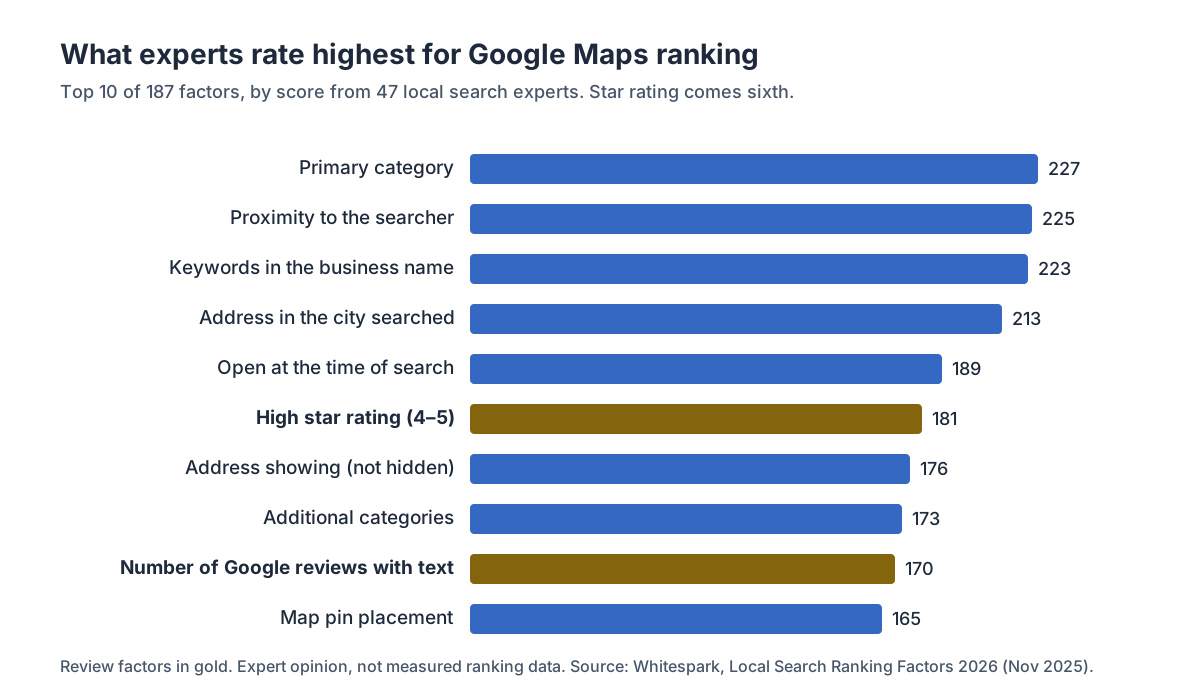
Four of the top ten are things you set in your profile (category, hours, extra categories, pin). Three are about where you are and whether that address shows. One, keywords in the business name, is mostly off-limits: you can’t add words to your name on Google that aren’t in your real name.
Is it just because they’re closer to the searcher?
It can be a large part of it, and it’s the one factor you can’t change. Whitespark’s experts rate “Proximity of Address to the Point of Search” second of 187. Google defines distance from where the searcher is, and if they don’t share a location, it uses what it knows about it.
That is why “rank #1 everywhere” isn’t a realistic goal for a business with one location. A poster on r/localseo quoted a client who wanted exactly that: “I want my Google Business Profile to rank #1 everywhere. No matter where I go, when I search the keyword, my business should appear on top.” A chain with five locations has five points to be close to. You have one.
If you serve customers at their homes, note one finding before you change anything. Sterling Sky’s study found a negative correlation between hiding the address and ranking in the map, for the five “near me” searches it covered. Google’s guidelines still say “If you’re a service-area business, you should hide your business address”, so don’t show a home address to chase rank. If you do have a staffed location that customers can visit, show it.
Is my competitor breaking Google’s rules?
Sometimes. Three things to look for: extra words in the business name, addresses where the business isn’t really located, and paid or incentivized reviews. You can report all three to Google.
Keywords in the name. Google’s guidelines say “Including unnecessary information in your business name isn’t permitted, and could result in the suspension of your Business Profile.” It can work: in an older test, written up in 2023, Sterling Sky added a keyword to a restaurant’s business name and saw rankings rise, and describes a business that fell from first to seventh two days after Google removed the extra words from its name.
Fake locations and paid reviews. A poster on r/GoogleMyBusiness describes a competitor that “setup a GMB for each city, and paid for reviews… It’s actually working for them as they’re ranking #1 in the map pack.”
How to report it, from Google’s Maps help:
- Misleading information: on Google Maps, open the business, select Suggest an edit, then Place is closed or not here, then Offensive, harmful, or misleading, and submit.
- Suspected fraud (misleading names, phone numbers or website addresses): use Google’s Business Redressal Complaint form. It accepts multiple businesses at once.
- Reviews for rewards: in the Google Maps app, open the business, tap Suggest an edit, then Report business conduct.
Keep screenshots of what you report: the name on Google, the name on their sign or website, and the address. Sterling Sky says “it often does take multiple reports to get Google to act on it.”
Don’t copy them. Google says extra words in the name could get a profile suspended, and its profile restrictions page lists blocking new reviews, unpublishing existing ones and showing a warning. What the FTC and Google allow covers the review rules.
What to fix first, smallest change first
Start with what you can change in your profile today, then the slower work that builds over months.
- Search like a customer. Check from the areas you want work in, not from your desk, so you’re fixing the right problem.
- Primary category. Pick the one that best matches your main service. Google’s guidelines say to use “the fewest number of categories it takes to describe your overall core business.”
- Hours and details. Accurate hours, phone, website and services. Google says inaccurate info can stop a profile showing “for relevant searches in your area.”
- Name and address. Your real name only. Show your address if customers can visit a staffed location there.
- A steady flow of reviews. Ask after every finished job, every week, rather than in bursts. Timing and scripts are here.
- Report clear rule-breaking by competitors, with evidence.
- The slower work: a website page for each service, links from local and industry sites, and listings on the directories for the work you do. This kind of work builds over months, which is where ongoing help may be worth paying for.
You can stop after step 5 if you now show for your main services in the areas you care about.
| Factor | Can you change it? | What to do |
|---|---|---|
| Distance to the searcher | No | Check rank from customers’ areas |
| Primary category | Yes, today | Pick your core service |
| Business name | Only to your real name | Remove extra words |
| Hours | Yes, today | Match when you take calls |
| Reviews this month | Yes, every week | Ask after every job |
| Star rating | Slowly | Good work; fix problems fast |
| Links and mentions | Over months | Service pages, local links |
Worked example: why the chain wins one search
Example, not real data. Two fictional businesses, one search. A homeowner types “roofer” on their phone. Every input below is an assumption to show how the factors trade off.
| Factor | You | The chain | Edge |
|---|---|---|---|
| Star rating | 4.8 | 4.3 | You |
| Total reviews | 140 | 90 | You |
| Reviews in the last 30 days | 1 | 9 | Chain |
| Distance from the searcher | 6 miles | 1 mile | Chain |
| Primary category | Contractor | Roofing contractor | Chain |
| Open when they search (Sunday) | Listed closed | Listed open | Chain |
You win on the two numbers you’re proud of. The chain wins on three things Whitespark’s experts rate above star rating (category, proximity, open hours), plus review recency, which they rate 11th. Now change only what you control: switch your category to “Roofing contractor” if it’s accurate, list the Sunday hours you actually take calls, and ask every customer for a review so you’re getting a few each week. Distance still favours the chain for this homeowner, but you’ve closed three of the four gaps, and for a homeowner halfway between you, you’d now stand a better chance.
Numbers we left out
These figures turn up in articles on this topic. We traced them and didn’t use them.
- Businesses in the 3-pack “receive 126% more traffic than those ranked 4-10”. A marketing agency’s claim we couldn’t trace to a method or dataset.
- “Reviews make up X% of Google’s local ranking.” The factor-weight percentages we found came from expert surveys, not from Google or from measuring rankings. We used Whitespark’s ranked list above, labelled as expert opinion, and left the percentages out.
Where this breaks down
- No one outside Google knows the formula. Google says it keeps “the search algorithm details confidential”. Whitespark’s list is expert opinion, and Sterling Sky’s findings are correlations.
- You can’t beat distance. A competitor much closer to a searcher may stay above you for that searcher whatever you do.
- Reports don’t always work. Google decides what it acts on, and it may take more than one report.
- The map isn’t the only place customers look. People who hear about you from a referral may search your name; the rating and replies matter there even when ranking doesn’t.
How Leadio does it
Leadio’s Local SEO & AI Answers is an ongoing program, with a three-month minimum, built around these factors. It covers your Business Profile (categories, services, service areas, photos and details kept complete and current, with weekly posts and a monthly profile review), a page on your website for each service and area you want to rank for, citation cleanup, links and coverage from relevant sites, and a monthly check of how AI assistants describe you. Every program starts with a baseline, and we never promise a ranking.
Reviews have their own owner: Review Booster sends a consistent request after completed work, without screening customers for positive reviews.
If you want the map work run for you, see how Local SEO & AI Answers works.
FAQ
Why does a business with fewer reviews rank higher on Google Maps? Because Google ranks on relevance, distance and prominence, not stars alone. A competitor closer to the searcher, in a better-matched category, or getting reviews more recently can rank above a business with more or better reviews.
Does star rating affect Google Maps ranking? Yes. Google says more reviews and positive ratings can help local ranking. In Whitespark’s 2026 expert survey, a high star rating ranked sixth among Maps factors, behind category, proximity, name keywords, location and hours.
How do I report a competitor’s fake Google Business listing? On Google Maps, open the listing, select Suggest an edit, then Place is closed or not here, then Offensive, harmful, or misleading. For suspected fraud, use Google’s Business Redressal Complaint form. Keep screenshots as evidence.
Should I put keywords in my Google business name? Not unless they’re part of your real business name. Google says unnecessary information in the name isn’t permitted and could get the profile suspended.
Why do I rank well at my office but not in other parts of town? Distance. Google ranks partly on how far each business is from the person searching, so results change with the searcher’s location. Check from the areas you want work in.
Local SEO & AI Answers
A long-term managed SEO program: your Business Profile, service and location pages, articles, links and PR, with AI answers tracked.
More from get found.
Are your Facebook leads junk, or just slow to reach?
Before you blame Meta for bots, check how fast your team called. Facebook lead forms are built for volume by default, and a lead reached the next day is a different lead. A three-question check, the form settings to change, and when to go further.
Can an AI clone of you post for your business, and should it?
An AI clone built from your voice and likeness can deliver videos you never filmed. Whether it helps or costs you trust comes down to consent, disclosure and what you use it for. What the research says, how the capture session works, and when not to use one.
Google now charges for some missed LSA calls: what changed on 1 October 2026
Since 1 October 2026, a Local Services Ads call you miss during business hours can be charged as a lead if the caller stays on the line for more than 20 seconds. Here is the rule, what it costs you, and the smallest fixes.
See where your leads are leaking.
Find out which stages are leaking, who we'd staff to plug them, and which Growth Team follows.