
Is it legal to ask customers for reviews? What the FTC and Google allow in 2026
Asking customers for reviews is legal. Review gating, paying for good reviews, fake reviews and hiding bad ones are not. Here is where the FTC rule and Google's policy differ, what the penalties are, and a five-step check of your own process. Not legal advice.

The short answer. Yes. Asking your customers for reviews is legal, and the FTC’s review rule treats “generalized solicitations to purchasers” differently from fake and insider reviews. What gets a business in trouble is asking only the customers you expect to be happy, paying for positive reviews, posting fake ones, and hiding or threatening negative ones. Google is stricter than the FTC: it bans incentives of any kind. For knowing violations of the FTC rule, courts can impose civil penalties, which the FTC’s December 2025 warning letters put at up to $53,088 per violation.
This is a plain-English summary of the published rules as of October 2026, not legal advice. If you have a specific situation, ask a lawyer.
Who this is for. You ask customers to review you after a job, an appointment or a visit, by yourself, through your staff, or through software. You’ve heard that “review gating” is banned, or that you can’t offer a discount for a review, and you want to know what is actually allowed before you change anything.
Is it legal to ask customers for reviews?
Yes. Neither the FTC nor Google stops a business asking its customers for reviews. The FTC’s Consumer Reviews and Testimonials Rule (16 CFR Part 465, in effect since October 21, 2024) exempts “generalized solicitations to purchasers” to post reviews about their experiences from its fake-review and insider-review provisions. Google’s own Business Profile help tells businesses to remind customers to leave reviews and gives them a link and QR code to do it.
The rules are about how you ask, who you ask and what you give in return. They also cover fake reviews, insider reviews and hiding the bad ones.
What is review gating, and is it illegal?
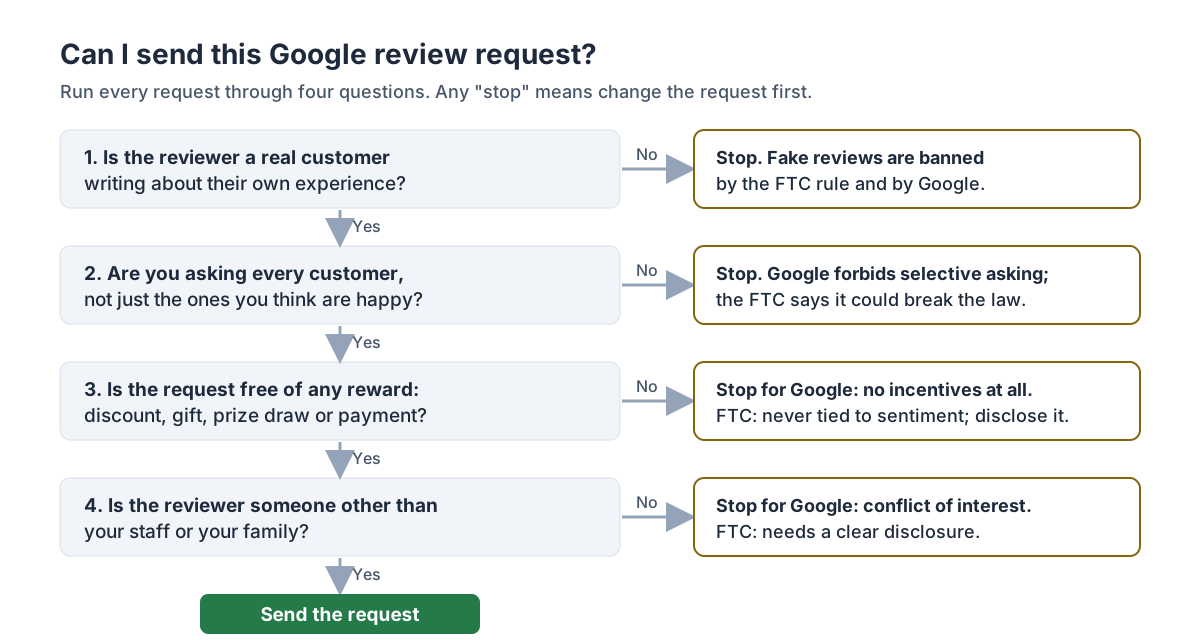
Review gating is asking customers how happy they are first, then sending only the happy ones to Google and the unhappy ones somewhere private. Google forbids it outright. The FTC rule does not name it, but the FTC says it “could violate the FTC Act”.
The two primary texts, in their own words:
- Google, in its Maps user-contributed content policy: merchants may not “Discourage or prohibit negative reviews, or selectively solicit positive reviews from customers”.
- The FTC, in its Q&A on the rule: the rule “does not contain a specific prohibition against such conduct”, but the practice “could violate the FTC Act”. The FTC’s 2022 guide for marketers is blunter: “Don’t ask for reviews only from customers you think will leave positive ones.”
So the practical answer is the same under both: ask everyone, the same way.
”Why would I send an unhappy customer to Google?”
It’s a fair question, and it deserves a straight answer: you don’t have to send anyone anywhere first. You can still talk to an unhappy customer, apologise and fix the problem. What you can’t do is make whether they get the review link depend on how happy they are.
Keep the two jobs separate:
- Service recovery is for anyone with a problem. Call them, put it right, and do it whether or not they ever review you.
- The review request goes to every customer with a finished job, at the same point, with the same words.
A customer whose problem you fixed may say so in their review, and your public reply shows the next buyer how you handle things when they go wrong. If you need the timing and scripts for asking everyone, our guide to when to ask for a Google review has them.
Can I offer a discount or a prize for a review?
Not for Google reviews. Under the FTC rule, an incentive is allowed only if it isn’t tied to the review’s sentiment, positive or negative, and the FTC says it should be disclosed; Google bans incentives entirely, so the stricter rule decides what you can do on your Google profile.
- The FTC rule (§ 465.4) bans compensation or incentives “conditioned expressly or by implication” on a review “expressing a particular sentiment, whether positive or negative”. The FTC’s Q&A adds that the rule “does not prohibit giving incentives for reviews” without that condition, and its 2022 guide says an incentivized review should disclose the incentive.
- Google does not allow merchants to “Offer incentives – such as payment, discounts, free goods and/or services – in exchange for posting any review”, or for changing or removing a negative one. Its help page calls this “strictly prohibited”.
- Yelp goes further than both: its support page says “Don’t ask anyone to review your business”, and that its software may not recommend reviews that look requested.
We read a prize draw “for everyone who leaves a review” as an incentive under Google’s policy, even if it isn’t tied to stars.
Can my employees, friends or family review my business?
On Google, no. Google’s policy treats reviews “based on a conflict of interest”, including “current or former employment” and “familial relationships”, as content it doesn’t allow. The FTC rule requires owners and managers who review their own business to disclose the relationship. If they ask staff or close relatives for reviews, they must tell them to disclose the relationship; the rule holds them responsible if such a review appears without one and they didn’t. The FTC’s 2022 guide says staff and family reviews should disclose the connection.
The simplest rule for a small business: staff and family don’t review the business on Google. If they want to help, they can share the link with real customers.
What’s allowed and what isn’t, side by side
Each row is one thing a business might do, checked against the FTC rule and Google’s policy.
| What you do | FTC rule | |
|---|---|---|
| Ask every customer for a review | Allowed | Allowed |
| Ask only customers you think are happy | Could violate the FTC Act | Not allowed |
| Reward any review, good or bad | Allowed; disclose it (FTC Act) | Not allowed |
| Reward only positive reviews | Not allowed | Not allowed |
| Write or buy fake reviews | Not allowed | Not allowed |
| Staff or family review the business | Needs clear disclosure | Not allowed |
| Pressure customers to review on the spot | Not addressed by the rule | Not allowed on the premises |
| Set staff quotas for review counts | Not addressed by the rule | Not allowed |
| Groundless legal or physical threats over a review | Not allowed | Not Google’s rule |
| Show only good reviews on your own site | Not allowed if presented as most or all | Not Google’s rule |
Two rows need a note. Google’s pressure rule is specific: its policy says merchants “should not require or pressure users to leave ratings or write reviews while on the premises”. And the FTC’s rule on your own website (§ 465.7(b)) bans presenting your displayed reviews as most or all of the reviews you received while suppressing ones based on rating or negative sentiment. It allows you to withhold reviews for reasons applied to all reviews equally, such as abusive content, personal information or reviews you reasonably believe are fake.
What are the penalties?
From the FTC, civil penalties that a court can impose for knowing violations of the rule. From Google, removed reviews and profile restrictions; Google’s restrictions page lists blocking new reviews, unpublishing existing ones and showing a warning.
- FTC. The FTC’s Q&A says the rule “authorizes courts to impose civil penalties for knowing violations”. The maximum is set in 16 CFR § 1.98, currently $53,088 for this kind of violation. On December 22, 2025, FTC staff sent warning letters to 10 companies about possible violations; the FTC said the letters “are not formal determinations” that the companies broke the rule.
- Before the rule existed, the FTC already acted under the FTC Act. In January 2022, online retailer Fashion Nova agreed to pay $4.2 million to settle allegations that it “suppressed reviews with ratings lower than four stars out of five” on its own website.
- Google. Its policy says incentivized or biased reviews “are not allowed and will be removed from Maps”. If Google decides a business broke its fake engagement policy, its help page on profile restrictions says it may stop the profile receiving new reviews for a set period, unpublish its existing reviews for a set period, or display a warning that fake reviews were removed. Google says it emails the owner first, and the owner can appeal.
In our view, the Google consequences are the more immediate risk for a small business, because the profile is where your Google reviews appear.
How to check your own review process, smallest change first
Start with what you say and send, then the software, then your website. Each step is a wording change, a setting or a message.
- The ask. Read your review text or script out loud. Does it go to every customer? Does it mention anything in return? Fix the wording first; it costs nothing.
- The software. Find any rating screen, “funnel” or routing rule that runs before the Google link. Turn it off, or set it so every customer sees the link whatever they answer.
- The website. Look at your testimonials page or review widget. If it filters by stars, either show everything or label it clearly as a selection, not your overall rating.
- The people. Tell staff, family and friends not to review the business, and stop any staff targets for review counts.
- The record. Write the one-sentence policy from the quick wins, and keep a note of the date you changed each thing.
If all five come out clean, you’re done. Going further, such as a legal review of your contracts with review vendors, makes sense if you run many locations or use incentives on platforms other than Google.
Worked example: auditing one review process
Example, not a real business. A fictional business, Halden & Co, runs this process. Here is each step, checked against the rules above.
| Step in Halden & Co’s process | Problem | Fix |
|---|---|---|
| Text: “Rate us 1 to 5” | Screens customers first | Send the review link to everyone |
| 4 or 5 stars get the Google link | Review gating | Same link for every answer |
| 1 to 3 stars get a private form | Hides unhappy customers | Offer the form and the link together |
| ”$10 off your next service for a Google review” | Banned on Google | Remove the offer |
| The owner’s brother left a 5-star review | Conflict of interest on Google | Ask him to remove it |
| Website shows “Our reviews”, 5-star only | Could mislead under FTC rules and guidance | Show all, or label as a selection |
After the fixes, Halden & Co asks every customer the same way, with no reward, and its website says which reviews it shows. None of that stops it fixing a problem for an unhappy customer before or after they review.
Numbers we left out
- “Fines of $51,744 per violation.” That was the maximum in 16 CFR § 1.98 as it stood in August 2024, when the FTC finalised the rule. The current maximum in 16 CFR § 1.98 is $53,088, and it is a ceiling a court can impose for knowing violations, not an automatic fine per review.
- Fashion Nova’s $4.2 million as a review-gating penalty. It is tempting to quote it that way, but the FTC’s complaint was about suppressing lower-rated reviews on Fashion Nova’s own website, not about which customers it asked, and it predates the 2024 rule.
Where this breaks down
- This is not legal advice. It summarises published federal rules and Google’s policy as of October 2026. State consumer-protection laws, other countries’ laws and your contracts may add to them.
- Other platforms have their own rules. Yelp asks businesses not to request reviews at all. Industry review sites and app stores set their own terms.
- Policies change. Google revises its help pages and policies, and the FTC adjusts penalty amounts for inflation. Check the linked pages before you rely on a detail.
- Some businesses break the rules anyway. A poster on r/GoogleMyBusiness describes a competitor that “paid for reviews… It’s actually working for them”. That isn’t permission: Google’s restrictions and the FTC’s penalties fall on the business that gets caught, not on the one that complained.
How Leadio does it
Leadio’s Review Booster is built around these rules. We send agreed invitations after completed work to every customer who meets the trigger, without selecting anyone by satisfaction. Service recovery is kept separate from whether someone is asked to review: customer problems go to the person responsible for resolving them. We monitor the agreed platforms and prepare or manage approved responses. We don’t promise a rating or the removal of criticism.
If your current process fails any of the checks above, see how Review Booster works.
FAQ
Is review gating illegal? Google’s policy forbids it. The FTC’s rule has no specific ban, but the FTC says asking only satisfied customers “could violate the FTC Act”, and its 2022 guide tells businesses not to do it. Treat it as off-limits.
Can I give customers a discount for leaving a Google review? No. Google prohibits incentives for reviews, including discounts, payment and free services. The FTC rule would allow a disclosed incentive that isn’t tied to the review’s sentiment, but Google’s policy is the one that decides what stays on your Google profile.
Can I ask customers to update or remove a negative review? You can reply, fix the problem and leave it to the customer. Google prohibits offering anything in exchange for revising or removing a review, and it forbids discouraging negative reviews. The FTC rule bans groundless legal threats, physical threats, intimidation, and public accusations the business knows (or recklessly ignores) are false, used to stop or remove a review.
Can my employees leave reviews for my business? Not on Google, which treats employment as a conflict of interest. Under the FTC rule and its 2022 guidance, staff reviews need a clear disclosure of the relationship, and owners or managers who ask staff for reviews must tell them to disclose it.
What happens if Google finds fake or incentivized reviews? Google removes them, and its help page says it may stop the profile receiving new reviews, unpublish existing ones for a set period, or show a warning to customers. It emails the owner first, and the owner can appeal.
Review Booster
Request reviews consistently, monitor feedback and manage agreed responses.
More from turn leads into customers.
AI receptionist vs answering service: what each answers, what each books, and what callers hear
An AI receptionist and a live answering service both pick up the phone. Compare them by what gets answered, what gets booked and who does the work after the call, and start with the hours you actually miss.
Do callers hang up on an AI receptionist? Some do, and here is why it still beats voicemail after hours
Some callers hang up the moment they hear an AI. If nobody covers your phone after hours, the alternative is voicemail, and in Invoca’s home-services call data fewer than 3% of callers sent there left a message. How to set up an AI receptionist so the callers who stay get an answer and the ones who hang up still get a callback.
How much does an AI receptionist or answering service cost? Compare it by cost per booked job
Ruby’s live receptionists bill by the minute, Smith.ai’s AI receptionist by the call, and a receptionist on staff by salary. None of those tells you what a booked job costs. Here is how to work that out with your own numbers.
See where your leads are leaking.
Find out which stages are leaking, who we'd staff to plug them, and which Growth Team follows.