
Should you follow up on an estimate? What to text when a customer goes quiet, without sounding desperate
A customer asked for a price, got it, and went quiet. Here is when to follow up, the exact texts and email to send, when to stop, and how to do it in fifteen minutes a week.
The short answer. Yes, follow up, but briefly and on a schedule you write down once: a few short messages over about two weeks, each easy to answer, ending with a polite “should I close this out?” In Hatch’s 2024 analysis of 163,212 estimate follow-up campaign launches by HVAC businesses on its software (vendor platform data), the average response rate was 60%. Those are customer responses, not signed jobs.
Who this is for. You sell by estimate or quote. Someone asks for a price, you visit or work it out, you send a number, and then the decision is theirs. You may be on a job when they are deciding, and nobody in the business has the job of chasing open quotes.
Should you follow up on an estimate at all?
Yes, if the job is worth more to you than the two minutes a message takes. A customer who goes quiet has not necessarily said no. They may be busy, waiting on a spouse, comparing prices or embarrassed that it has been so long. A short follow-up turns that silence into an answer, and a “no” you know about is still more useful than a quote you are guessing about.
”If they don’t call, they’re not interested.” Is that true?
Sometimes it is, and if your calendar is full all year, not chasing quotes is a reasonable choice. The trouble is that you can’t tell which silences are a “no” until you ask.
This camp is real and it is proud. On a 125-comment r/Contractor thread about customers who go quiet after an estimate, the top comment (82 upvotes) reads: “I send the estimate and never follow up. If they call they’re interested. If they don’t call they’re not interested. I stay busy all year.” If that describes you, the honest advice is that you probably have a pricing question more than a follow-up question: a business that is turning work away can raise its price.
For everyone else, the counter-evidence comes from other owners. A commenter on r/smallbusiness wrote: “1 customer told me once that he already had a cheaper quote but he was too embarrassed to call the guy back because it had been so long. It’s not uncommon for us to land the job on the 5th, 6th, 7th follow up.” Mike Agugliaro, writing in Plumber Magazine in 2018, describes the same thing from the homeowner’s side: non-urgent work moves “at a snail’s pace”, and people who let it slide can be “embarrassed to admit that the work hadn’t been done” or don’t think the old estimates “are even valid anymore” and get new quotes.
Those are one commenter’s experience and one writer’s view, not a measured rate. They are still the reason a short follow-up is worth sending: it gives a customer who meant to call you an easy way back in.
The other half of the objection is “I don’t want to look desperate.” That is about tone, and tone is fixable. A commenter on r/cleaningbusiness put it plainly: “If follow-up is case by case, it gets decided by mood, and the mood is always ‘I don’t want to seem pushy,’ so it quietly never happens. A written sequence takes the decision away.” Short, friendly, easy to answer, and finished after a set number of messages: that doesn’t read as desperate.
When should you send the first follow-up?
Within a few days of sending the price, while the customer still remembers your visit. Joist, which sells estimating software, advises: “Send your initial follow-up 2–5 days after you send your initial estimate email.” Hatch describes the campaigns in its study as two-day follow-ups, triggered two days after the estimate. Neither is a controlled test of timing, so treat “two to five days” as a sensible starting point, then check your own replies.
What should you text a customer who went quiet after a quote?
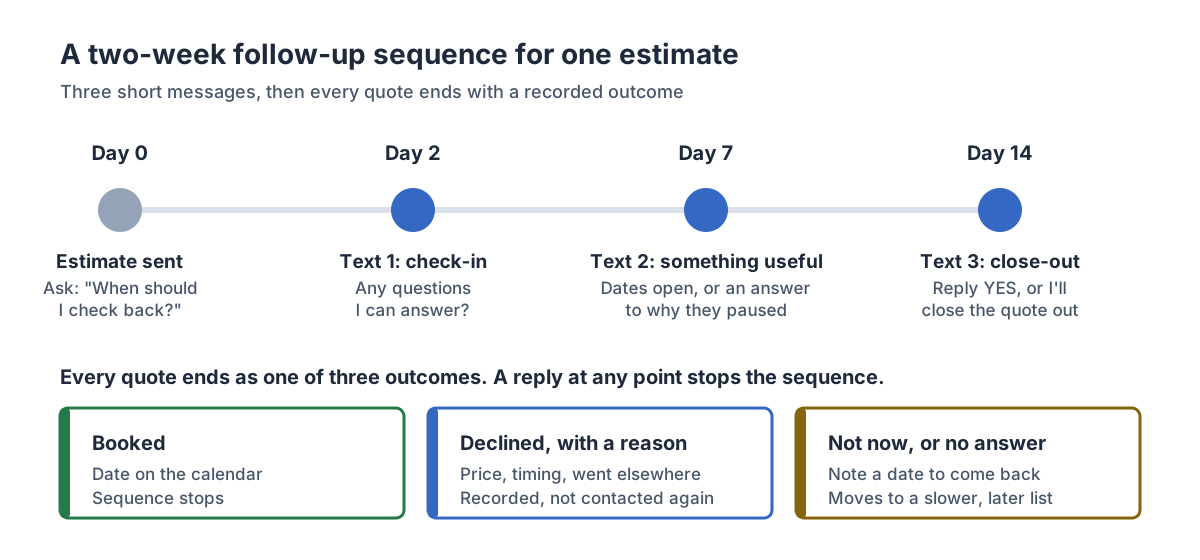
Something short that they can answer in one word. The three messages below cover a two-week sequence. Change the names, the job and the dates; keep them short.
Message 1, day 2: the check-in.
Hi Sam, it’s Alex from Larkspur. Just checking the gutter quote came through OK. Any questions I can answer?
Message 2, about day 7: something useful.
Hi Sam, Alex again. We’ve got two openings for gutter work the week of the 20th if you’d like one. Happy to talk through the quote by phone if that’s easier.
If you know why they hesitated, swap in a line for that reason (see the table below). Send something useful rather than “just following up”.
Message 3, about day 14: the close-out.
Hi Sam, I’ll close out the gutter quote this week so it doesn’t sit open. If you still want it done, just reply YES and I’ll call you. No problem either way.
The close-out question comes from the same r/cleaningbusiness thread: “‘still need this cleaned, or should I close the quote out?’ gives them an easy yes/no and clears your pipeline either way.” It’s worth sending because it is honest. You really are closing the quote, and saying “no problem either way” makes “no” easy to send.
If you’d rather email (for larger jobs, or customers who asked for it in writing):
Subject: Your gutter quote from Larkspur
Hi Sam,
Thanks again for having us out on Tuesday. Your quote is attached, and it’s valid until November 15.
If it helps, the two decisions left are the gutter color and whether to add guards. I’m happy to talk either through on a five-minute call.
If you’d like to go ahead, reply to this email and we’ll book a date. If you’ve gone another way, a quick note saves me chasing you.
Alex Rivera, Larkspur Exteriors
What do you say when you know why they went quiet?
Match the message to the reason. If the customer told you something at the visit, or you can make a fair guess, the second message can do more than check in.
| Reason they paused | What to send |
|---|---|
| Price felt high | A smaller first phase, or what’s in the price |
| Waiting on a partner | Offer a call with both of them |
| Getting other quotes | What your quote includes that others may not |
| Timing | Ask when to check back; set that date |
| Unsure about the work | One photo or example of a similar job |
On price, be careful with discounts. In Siro’s 2026 vendor data from 53,389 recorded in-home sales appointments, concessions sellers offered unprompted closed slightly less often than ones given in response to something the homeowner said. Answering a price worry with what the job includes, or a smaller first stage, finds out what the real concern is before you give away margin.
How many times should you follow up on a quote?
Three messages over about two weeks is a reasonable default, then stop and record the outcome. Joist suggests that “after 3+ follow-ups, it’s likely you’re wasting your efforts”, while the r/smallbusiness commenter above reports landing jobs on the fifth to seventh follow-up. Both are opinions. What matters more than the count is that the sequence ends: a reply, a “no”, a “not now” with a date, or your close-out message.
A “not now, maybe spring” isn’t a lost quote. Write the date down. When spring comes, that customer belongs on a separate, slower list, which is the subject of how to win back customers who haven’t booked in a year.
How to set this up yourself, smallest change first
- Ask for the check-back date at the estimate. Free, no software. Whatever they say becomes your first follow-up.
- Send one message two to five days later. Just Message 1. This alone is aimed at the customer who meant to reply and forgot.
- Write the full three-message sequence once, save it as shortcuts, and run it from a list (a spreadsheet works) during your weekly 15 minutes.
- Record why each quote ended: booked, price, went with someone else, timing, no answer. After a few months you should be able to see whether your problem is follow-up or the estimate itself.
- Go further only when the list outgrows you. If you send more quotes than you can track in a weekly sitting, or replies arrive while you’re on a roof, that’s when automated sending or someone else handling replies, such as a managed follow-up service, earns its cost.
Doing it yourself, with software, or with help: how do they compare?
| Option | Who sends | Who answers replies | When it stops | Your time each week |
|---|---|---|---|---|
| No follow-up | Nobody | You, if they call | Never starts | None |
| When you remember | You | You | When you forget | Unpredictable |
| Written sequence, sent by you | You | You | After message 3 | About 15 minutes |
| Automated texts from software | Software | You | When you set rules | Replies only |
| Managed follow-up | A service | The service, then you | Agreed stop rules | Decisions only |
The risk with automated sending: messages go out on time, but replies can land in an inbox nobody watches, so a customer who answers “can you do Thursday?” hears nothing back. Whatever you use, decide who answers replies and how fast.
What it’s worth: a worked example
Example, not a statistic. Every input is an assumption. Swap in your own.
- You send 30 estimates a month. 12 sign at the visit or soon after; 18 go quiet.
- An average job is worth $3,000 to you.
- A three-message sequence to the 18 quiet quotes is 54 short texts, about an hour a month of your time, plus a few calls for replies.
- Suppose the sequence turns 2 of those 18 into booked jobs that would otherwise have gone to someone else or nowhere.
That’s 2 jobs, $6,000 of work, for about an hour plus the calls. At these inputs the sequence pays for itself if it wins one job every few months. If your quiet quotes really are all “no”, the sequence costs you an hour a month and tells you so, which is worth knowing when you price the next job.
Numbers we left out
These figures turn up in estimate follow-up articles. We traced them and didn’t use them.
- “80% of sales take five or more follow-ups.” Carly traces it to a 1942 survey of one sales association chapter, with fewer than 40 respondents. The Hatch article we cite repeats a variant, “8–12 touches to close a deal for 80% of deals”, credited to an outside source; we didn’t use that line either.
- “Structured follow-up raises estimate close rates 12–18 points, according to ServiceTitan.” It appeared on a third-party blog. We found it on no ServiceTitan page.
Where this breaks down
- Replies aren’t jobs. Hatch’s 60% counts responses to its customers’ campaigns, in HVAC, measured by the company that sells the software, and it doesn’t define a response. A reply can be “no thanks”. Count your own booked jobs.
- Some quiet quotes are a “no”. A short sequence finds that out faster; it doesn’t change it.
- Follow-up can’t fix a quote that was wrong for the customer. If most of your losses come back as “price” or “went with someone else”, look at what happens at the appointment. That’s covered in what recorded in-home appointments show about why estimates stall.
- Texting rules apply once you automate. Texting a customer who just asked you for a price is different from sending automated marketing texts, which bring consent rules into play. The basics are in our guide to contacting old leads; for anything specific, ask a lawyer.
How Leadio does it
Leadio’s Lead Nurture Ladder is this kind of sequence, run for you. We agree which open quotes enter it, the cadence, the channels and the conditions that stop or change it. We send the approved messages, answer replies, record whether each quote booked, declined or opted out, and route pricing questions and decisions to your team. You set the prices and close the sales; follow-up stops or changes for replies, decisions and opt-outs.
If your quotes get answers but still don’t close, that is a different problem, and Closing Coach works on the appointment itself.
Show us how a quote is followed up today and where conversations stop: talk to us about the Lead Nurture Ladder.
FAQ
How long should you wait to follow up on an estimate? Two to five days is a sensible start. Joist recommends that window, and Hatch describes the campaigns in its study as two-day follow-ups. Better still, ask the customer at the visit when you should check back.
Is it pushy to follow up on a quote? Not if the message is short, friendly, easy to answer and part of a sequence that ends. Pushy is fake urgency or messages that never stop.
What do you say when a customer ghosts you after a quote? Send a yes-or-no question: “Still want to go ahead, or should I close out the quote?” It gives them an easy way to say either.
Should I text or email an estimate follow-up? Text for the short check-ins if the customer gave you a mobile number and has been texting with you; email for the quote itself and anything detailed. Use what the customer used to reach you.
When should I stop following up on an estimate? After a reply, a booking, a clear “no”, an opt-out, or your close-out message. A “not now” gets a date and goes on a separate list for later.
Lead Nurture Ladder
Timed follow-up for every new lead, then follow-up that fits where each lead stands, until it reaches a yes, a no or an opt-out.
More from turn leads into customers.
AI receptionist vs answering service: what each answers, what each books, and what callers hear
An AI receptionist and a live answering service both pick up the phone. Compare them by what gets answered, what gets booked and who does the work after the call, and start with the hours you actually miss.
Do callers hang up on an AI receptionist? Some do, and here is why it still beats voicemail after hours
Some callers hang up the moment they hear an AI. If nobody covers your phone after hours, the alternative is voicemail, and in Invoca’s home-services call data fewer than 3% of callers sent there left a message. How to set up an AI receptionist so the callers who stay get an answer and the ones who hang up still get a callback.
How much does an AI receptionist or answering service cost? Compare it by cost per booked job
Ruby’s live receptionists bill by the minute, Smith.ai’s AI receptionist by the call, and a receptionist on staff by salary. None of those tells you what a booked job costs. Here is how to work that out with your own numbers.
See where your leads are leaking.
Find out which stages are leaking, who we'd staff to plug them, and which Growth Team follows.