
Why aren't my estimates converting? What 53,389 recorded in-home appointments show about where sales stall
A vendor recorded 53,389 in-home sales appointments in 2026. Its data points to three places a sale stalls at the table: the decision-maker nobody confirmed, the discount nobody asked for, and the "let me think about it" with no next step.

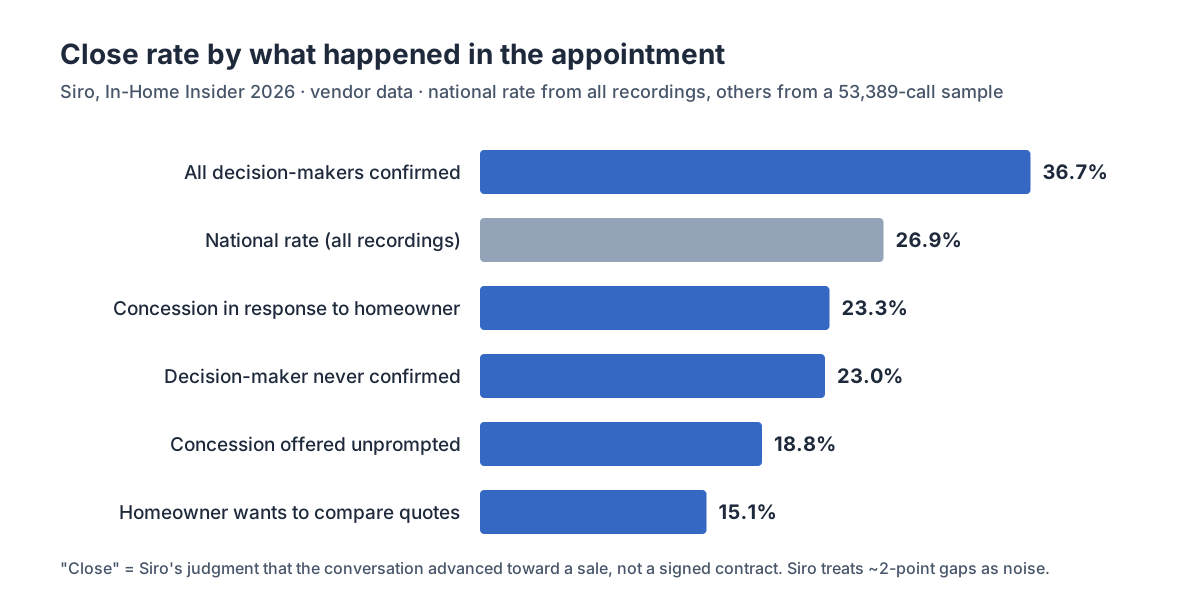
The short answer. The sale can stall at the appointment, before any follow-up starts. In 53,389 in-home sales appointments that the software company Siro recorded between April and August 2026, appointments where the seller never confirmed who makes the decision closed at 23.0%. Appointments where all the decision-makers were confirmed closed at 36.7%. “Close” here is Siro’s own judgment that the conversation advanced toward a sale, not a signed contract.
Who this is for. You sell at an appointment: you or your team visit, measure or talk it through, and present a price, whether at someone’s kitchen table or on a video call. You book enough appointments. Too few of them turn into work, and when they don’t, you may not find out why.
What does the Siro data actually measure?
Siro sells software that records and analyses in-person sales conversations, and its 2026 In-Home Insider report is drawn from 53,389 in-home sales consultations recorded on it between April and August 2026. It is vendor data from companies that already record their appointments, so read it as a large sample of those sellers, not of every business.
The number to understand first is the definition. Siro says its close rates reflect “Siro’s own judgment of whether a conversation advanced toward a sale, not a signed contract or revenue figure.” Siro also says to “treat a two-point difference between two groups as noise and a twenty-point difference as real.” Every figure below uses Siro’s definition, and the small gaps should be read with that warning.
What’s a good close rate for in-home appointments?
In Siro’s data, 26.9% of in-home consultations nationally ended in what it counts as a commitment. By region it ran from 31.1% in the Midwest to 23.3% in the South (West 27.2%, Northeast 24.3%). By trade, Windows & Doors had the highest average at 29.1% and Decks & Patios the lowest at 16.0%.
Use those as a rough frame, not a target. Your own close rate depends on how you count it (signed contracts, deposits, or “they said yes”), and Siro’s count is none of those exactly. The more useful comparison is your own number this quarter against last quarter, counted the same way.
”They just want the cheapest price.” Is it really price?
Not always. In Siro’s kitchen-table chapter, the objections about money weren’t the ones that closed worst. Appointments where the homeowner raised “can’t afford to pay” closed at 35.5%, and “sticker shock” at 32.2%, both above Siro’s 25.6% median for objections. The lowest-closing objection was “wants to get more or compare quotes”, at 15.1%.
A commenter on r/Roofing sees it differently: “‘Let me think about it’ is polite for they are not using you. It’s a smoke screen, and unless you can uncover the real objection they are never calling you back. (Most of the time it’s price).” The “most of the time it’s price” part is worth testing against your own appointments. In Siro’s homeowner chapter, “lower the total price” came up in nearly half of all appointments, yet was associated with only +0.5 points of close rate. “Wants to make an informed decision” appeared in 76% of appointments and was associated with a close rate 20.4 points lower.
None of this says price doesn’t matter. It says that a customer who says “price” may still buy, and a customer who wants to compare quotes, or wants to feel informed before deciding, is the one to plan for. Those need a different response from a discount.
Does it matter if the decision-maker isn’t at the appointment?
Yes, and it costs nothing to ask. In Siro’s data, the seller never confirmed who was actually in the room in 30.9% of appointments. Those appointments closed at 23.0%, against 36.7% where all decision-makers were confirmed.
That is a correlation, not proof that asking the question adds about 14 points. Sellers who confirm decision-makers may also be better at the rest of the appointment. But the question costs nothing, and you can ask it at two moments: at booking (“who else will be part of the decision, and can they be there?”) and at the start of the appointment (“is there anyone else who’ll want a say before you go ahead?”). If someone is missing, you can rebook, or plan a short call with them, instead of finding out after the price has gone cold.
Should you offer a discount to close the sale?
Not until the customer raises a concern it would answer. In Siro’s data, 73.7% of conversations included at least one concession, an average of 1.85 per appointment, and 44% of concessions were unprompted. Unprompted concessions closed 18.8% of the time; concessions given in response to something the homeowner actually said closed 23.3% of the time.
Siro’s own noise warning applies: that is a 4.5-point gap. Read it as “a volunteered discount closed no better than one given in response to the customer, in Siro’s data”, not as proof that discounts lose sales. It is also money: every unprompted discount on a job you’d have won anyway comes straight off your margin. Answer the concern the customer raised first, and keep the concession for a concern that needs one.
What do you do with “I need to think about it”?
Get a concrete next step before you leave. Siro groups the ways sellers respond to a stall, and the one it calls the “concrete next step” category (securing a real follow-up instead of resolving the objection on the day) closes lowest on the call itself (17.7%) but “recovers the stall more often than anything else (22.1%).” The urgency-and-discount reflex closed at 21.7%. Responses that reframed financing or reduced the customer’s commitment risk “both close above 32%.”
Siro also found a gap between sellers: top-tier reps “convert nearly 1 in 5 stalls into a commitment”, bottom-tier reps “roughly 1 in 9.” Siro found both groups try to handle objections at similar rates (87.9% vs 84.3%); the difference is in how often they recover the stall. How you respond at that moment is something a team can practise.
What those responses sound like in practice:
- A next step with a date: “What would you need to see to decide? Let’s put 15 minutes on Thursday evening with both of you.”
- Lower the commitment risk: “We can start with the front of the house and quote the rest after you’ve seen the work.”
- Reframe the payment: if you offer financing, show the monthly figure next to the total rather than waiting to be asked.
A commenter on r/salestechniques answered a post asking why customers ghost after a quote: “Because you need to close the deal before you send the quote… Don’t confuse positive reactions with buying signals. Many people just don’t want to hurt your feelings.”
Do longer appointments close more?
In Siro’s data they do, and Siro says it is “not because sitting in the home longer wins deals on its own” but because they contain more of what closes. Siro’s median appointment ran 75 minutes. Longer appointments (the top quarter, 113 minutes or more, against the bottom quarter, 46 or less) were “2.35x as likely to include a real close attempt”, 1.79x as likely to include a financing conversation and 6.3x as likely to reach deeper discovery. That doesn’t mean you should stretch every visit. It means the shortened visit, the one that skips the questions and leaves a price on the counter, tends to skip the close attempt too, in Siro’s data.
How to find where your own estimates stall, smallest change first
- Count it the same way every month. Appointments held, and how many became signed work. Decide your definition once.
- Add the decision-maker question at booking and at the start of every appointment. Free, today.
- Never leave without a dated next step. Then follow up on that date; here’s what to text when a customer goes quiet.
- Log every loss with a reason for a month, and count how many are “unknown”. A commenter on r/Roofing said it plainly: “Most of the time I lose jobs I never really know the reason why and it eats at me.”
- Listen to real appointments, with permission. A commenter on r/Sales_Professionals credited call review: “memory is pretty bad at showing you what actually happened.”
- Practise the moment that keeps going wrong. Once you know whether it’s the missing partner, the early discount or the stall, rehearse that one moment. Go further, into software or sales coaching, when you have more appointments than you can listen to yourself.
Riding along, recording, software or coaching: how do they compare?
| Option | What gets reviewed | Who coaches | Who does the work |
|---|---|---|---|
| Owner rides along | A few visits | You | You, in person |
| Record and self-review | Calls you pick | You | You, after hours |
| Recording software | Many calls, scored | You or a manager | Software scores; you coach |
| Sales trainer or course | General technique | The trainer | Your team attends |
| Managed coaching | Your agreed calls | A coach, with you | Coach reviews; team practises |
Software tells you where conversations differ. Somebody still has to turn that into practice, so ask who that will be before you buy.
What it’s worth: a worked example
Example, not a statistic. Every input is an assumption. Swap in your own.
- Your team runs 40 sales appointments a month and signs 10 of them (25%).
- An average signed job is worth $8,000.
- The team doesn’t confirm decision-makers on about a third of appointments, roughly 13 a month.
- Suppose asking the decision-maker question on those 13 wins one extra signed job a month.
One extra signed job a month is $8,000 of work and moves your close rate from 25% to 27.5%. Over a year that is $96,000 of work from appointments you already had.
Two cautions. First, at 40 appointments a month, 2.5 points is one job, so you need several months of your own numbers before you can tell a real change from a lucky month. Second, don’t plug Siro’s 23.0% and 36.7% into your own figures: they describe Siro’s customers and Siro’s definition of close, and the gap is a correlation.
Numbers we left out
These figures turn up when people sell sales tools. We traced them and didn’t use them.
- “+33% average increase in close rate.” It appears on Rilla’s home-services page, beside one customer’s logo, with no sample, period or method.
- Siro’s own “21% increase in close rate” on its homepage, for one named customer, with no baseline or method given beside it. We use Siro’s benchmark report above, which publishes its sample and definition, not its product claims.
- “Role-playing can improve sales performance by up to 20%.” A Hyperbound article credits it to research from Revnew.com, with no link, report or method. We couldn’t trace it.
Where this breaks down
- “Close” is Siro’s judgment. It is not signed contracts or revenue, and Siro says gaps of about two points are noise.
- It is one vendor’s customers. Companies that record every appointment may sell differently from those that don’t. Siro’s national and regional rates use its full set of recordings; trade and conversation-level figures use what it calls a geographically balanced sample of 53,389 calls.
- Correlation, not cause. Confirming the decision-maker goes with higher close rates; it may partly be what good sellers do anyway.
- Five months of 2026. The recordings cover April to August only, so seasonal differences are not in it.
- Some losses are right. A customer who can’t afford the job, or wants something you don’t do, shouldn’t be closed.
How Leadio does it
Leadio’s Closing Coach works on the appointment itself. We organise your offer, the questions customers ask and your approved answers into a playbook; prepare your team before important appointments; review agreed recordings or transcripts against your sales framework, pointing to the moments that moved a buyer toward or away from yes; and turn what we find into focused practice. Your people run the appointments and close the sales. We confirm recording permissions and handling with you, and we don’t promise a close rate: where your records show appointments and outcomes, we compare them over time.
When the appointment goes well but the customer still goes quiet afterwards, the Lead Nurture Ladder keeps the open quote moving toward a clear next step.
Bring your sales process and the conversations your team finds hardest to win: see how Closing Coach works.
FAQ
What is a good close rate for in-home sales? In Siro’s 2026 data, the national figure was 26.9% (from its full set of recordings). In its 53,389-call sample, trades ran from 16.0% in Decks & Patios to 29.1% in Windows & Doors. Siro’s “close” means the conversation advanced toward a sale, so compare your own numbers over time rather than against that figure.
Why do customers ghost after an estimate? The silence itself doesn’t say. It might be a no they don’t want to say, a busy week, a partner who hasn’t seen the quote, or other quotes still coming in. In Siro’s data, homeowners who wanted to compare quotes closed at 15.1%, the lowest of any objection. In Siro’s data, securing a concrete next step recovered stalls more often than any other response it measured, so leave with one.
Should I give a discount to close a sale? Not until the customer raises a concern it would answer. In Siro’s data, unprompted concessions closed at 18.8%, against 23.3% for concessions given in response to something the homeowner said.
How do I handle “I need to think about it”? Ask what they’d need to decide, and book a specific time to talk again before you leave. In Siro’s data, securing a concrete next step recovered stalls more often than any other response it measured.
Is it legal to record sales appointments? The rules differ by state. Ask the customer’s permission, and check the state-by-state guide from the Reporters Committee for Freedom of the Press or a lawyer.
Closing Coach
Help your team turn more booked conversations into won work, using reviewed calls and focused practice.
More from turn leads into customers.
AI receptionist vs answering service: what each answers, what each books, and what callers hear
An AI receptionist and a live answering service both pick up the phone. Compare them by what gets answered, what gets booked and who does the work after the call, and start with the hours you actually miss.
Do callers hang up on an AI receptionist? Some do, and here is why it still beats voicemail after hours
Some callers hang up the moment they hear an AI. If nobody covers your phone after hours, the alternative is voicemail, and in Invoca’s home-services call data fewer than 3% of callers sent there left a message. How to set up an AI receptionist so the callers who stay get an answer and the ones who hang up still get a callback.
How much does an AI receptionist or answering service cost? Compare it by cost per booked job
Ruby’s live receptionists bill by the minute, Smith.ai’s AI receptionist by the call, and a receptionist on staff by salary. None of those tells you what a booked job costs. Here is how to work that out with your own numbers.
See where your leads are leaking.
Find out which stages are leaking, who we'd staff to plug them, and which Growth Team follows.