
Missed call text back: what it fixes, and what it misses (forms, DMs, the second message)
A missed call text back tells a caller you saw their call. It does nothing for form fills, social messages or the reply that comes back at 9pm. What to put in the first text, and what to set up around it.
The short answer. A missed call text back sends an automatic text when a call goes unanswered, so the caller knows you saw it and can reply when it suits them. That beats silence: Numa, which sells phone answering, says that in its 2020 data its customers saw up to 80% of callers choose texting over voicemail. What it misses is everything that didn’t start as a phone call (forms, chat, social messages) and the conversation after the first text, which still needs someone to own it.
Who this is for. You sell through an inquiry: someone calls, texts, messages or fills in a form, and the sale depends on getting them to an appointment, an estimate or a visit. You have a missed call text back set up, or you are being sold one, and you want to know what it will and won’t catch.
What is missed call text back?
It is an automation on your business number: when a call isn’t answered, it sends a text to the caller’s number from your line. The caller can reply by text, and those replies land wherever your system sends them. It only fires on a missed phone call, so it never sees an inquiry that arrived any other way.
Isn’t a text as good as answering?
Not quite. A text starts a conversation the caller can pick up later; it is not the conversation. A commenter on r/Plumbing made the case for texting: “Texts and voicemail solve the problem.” For callers who reply and get a quick answer, that’s fair.
The research on texting leads is older, from a vendor, and about leads worked by sales teams rather than callers, but it points the same way. In Velocify’s 2012 study of almost 3.5 million lead records from more than 400 companies, texting a prospect before phone contact “decreased the likelihood of ever contacting that lead by 39%”, while prospects texted only after first contact converted at more than twice the rate of the average contacted lead. A text is a strong second message and a weak substitute for a first conversation.
Calling back has its own problem. In Hiya’s 2019 call report, “only 48 percent of calls Americans receive on their phones are picked up”. Hiya’s data covers calls of every kind, robocalls included, but it means your callback may ring out too. A text gives the caller a way to reach you on their own time. A commenter on r/Roofers described what the text has to do: “An immediate text helps if it confirms they reached the correct business, sets a realistic callback expectation…”
What does missed call text back miss?
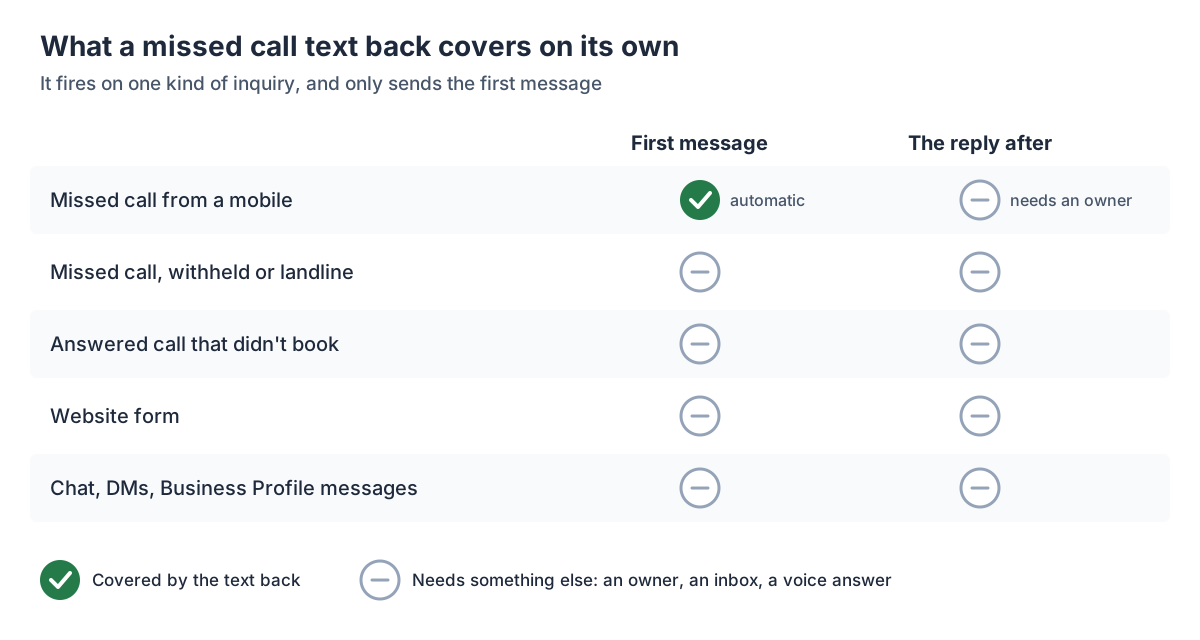
Five things, and each one is an inquiry you can lose with the text back working perfectly:
- Forms. A form filled in at night gets nothing from a missed-call tool. A poster on r/FacebookAds running ads for a dental clinic: “Leads fills out forms during evening or night while clinic close By morning when we try to followup they already lose interest…”.
- Social messages and chat. DMs, Google Business Profile messages and website chat aren’t phone calls, so a missed-call tool never sees them. In the 2025 Sprout Social Index, a survey of 4,044 consumers in the US, UK, Canada and Australia who follow at least five brands on social media, run for a company that sells social media software, 73% said they expect a response on social within 24 hours or sooner.
- The second message. When the caller texts back at 9pm, someone has to answer. A commenter on r/hvacadvice, who disclosed they sell in this space: “the missed call itself is only half the leak. The other half is that nobody owns what happens next.”
- Calls that were answered but not booked. The text only fires on missed calls. A call you picked up and didn’t book is a different gap, covered in AI receptionist vs answering service.
- Callers you can’t text. A withheld number can’t be texted, and a caller on a landline may never see the message.
What should a missed call text say?
Four things, in this order: who you are, that you got the call, one useful question, and when a named person will reply. A commenter on r/SaaS listed three of them: “an instant acknowledgement, one useful qualifying question, and a promised response window someone actually owns.”
During open hours:
“Hi, it’s [Name] at [Business]. Sorry we missed you, we’re on a job. What can we help with? [Name] will call you back by [time].”
After hours:
“Thanks for calling [Business]. We’re closed for the night. Reply with what you need and your area, and we’ll call you by 9am. Urgent? Call [on-call number].”
One follow-up, if there’s no reply:
“Still need help with [their request]? Reply here, or we’ll try you at [time]. Reply STOP and we won’t text again.”
Then call at the time you said. After that, stop unless they reply.
A measured approach
- Fix the first text. Use the four parts above. This costs nothing if you already have the tool.
- Give replies an owner and a window. Name who answers text replies in open hours and after hours, and how fast.
- Copy the same instant reply to your website form. An auto-reply on submission, plus a named person who follows up.
- Bring DMs and Business Profile messages into one place that someone checks on a schedule.
- If after-hours text replies are thin, add a voice answer for those hours. See what callers do when an AI answers.
- Follow up the ones who go quiet, with a stopping rule: a set number of attempts, then leave it.
What covers each kind of inquiry?
| Inquiry | Text back covers it? | What covers it |
|---|---|---|
| Missed call, mobile | First text only | A named owner for replies |
| Missed call, withheld or landline | No | A voice answer, or voicemail |
| Answered call, not booked | No | Asking for the booking |
| Website form | No | Instant reply plus an owner |
| Chat, DMs, Business Profile | No | One inbox someone checks |
| Caller texts back | Only if someone replies | A set response window |
| Goes quiet after replying | No | Follow-up with a stop rule |
Worked example: same text, different owner
Example, not a statistic. Every input is an assumption. Swap in your own.
- 40 missed calls a month. 10 are spam or existing customers, so 30 new inquiries get the text.
- 12 of the 30 reply.
- When someone actually talks to an inquiry and asks for the booking, 1 in 3 books.
| Who handles the replies | Replies reached | Booked jobs |
|---|---|---|
| Whoever sees them next morning | 6 of 12 | about 2 |
| A named owner within a set window | 10 of 12 | about 3.3 |
The text is identical in both rows. The difference is whether a reply at 9pm gets an answer before the caller moves on, which is an assumption here and something to measure in your own month. The 18 who never replied are a separate list for a callback at the time you promised.
Numbers we left out
- “98% of texts are opened.” We found no study behind it; it circulates without a source.
- “90% of texts are read within three minutes.” Same: no traceable source.
- “Texting lifts conversion 112%.” The figure appears in a chart in Velocify’s 2012 texting study, for texts sent after contact had been made. Versions that drop “after contact” leave out the same study’s warning that texting before contact cut the chance of reaching the lead.
Where this breaks down
- The texting research is about sales leads, not callers. Velocify studied lead records generated at 400+ of its customers in 2012, not callers who had just rung a business. Treat it as a direction, not a measurement of missed-call texts.
- Numa’s 80% is an upper bound from its own customers, not an average.
- Texting has rules. Software-sent texts need registration (Twilio), and you should honour opt-outs and check what consent you need. Confirm the details with your provider and your own adviser.
- A text can’t book a job by itself. Someone still has to reply, ask the question and offer a time.
How Leadio does it
Leadio’s Lead Nurture Ladder picks up active inquiries that didn’t get a decision on first contact and keeps them moving across the channels you agree, at an agreed cadence. It updates each opportunity when someone replies, books, declines or opts out, and records the next action and its owner. Follow-up stops or changes for replies, decisions and opt-outs.
The first answer is the job of two services. The 24/7 Answering Service is an AI receptionist, run for you, that answers calls and sends a text back when one is missed. 24/7 Chat & DMs answers website chat, texts and Facebook and Instagram DMs around the clock. Every conversation lands in the Universal Inbox with an owner. Between them, the missed call, the chat, the DM and the text reply each get an answer, day or night.
Try it: hear the AI receptionist, then read how the Lead Nurture Ladder works.
FAQ
What should a missed call text say? Who you are, that you got the call, one useful question, and when a named person will reply. Templates are above.
Does missed call text back work for landlines? It can’t text a withheld number, and a landline caller may never see the text. Those callers need a voice answer or a callback.
Do I need to register to send business texts? If the texts are sent automatically by software from a standard 10-digit number to US phones, yes: Twilio’s documentation says those senders must register for A2P 10DLC. A missed call text back sent from a local 10-digit number is that kind of text. Ask your provider whether your number is registered.
Is missed call text back better than an AI receptionist? They do different jobs. The text tells a missed caller you saw them and invites a reply later. An AI receptionist answers the call itself and can book it then. After hours, you can use both.
Lead Nurture Ladder
Timed follow-up for every new lead, then follow-up that fits where each lead stands, until it reaches a yes, a no or an opt-out.
More from turn leads into customers.
AI receptionist vs answering service: what each answers, what each books, and what callers hear
An AI receptionist and a live answering service both pick up the phone. Compare them by what gets answered, what gets booked and who does the work after the call, and start with the hours you actually miss.
Do callers hang up on an AI receptionist? Some do, and here is why it still beats voicemail after hours
Some callers hang up the moment they hear an AI. If nobody covers your phone after hours, the alternative is voicemail, and in Invoca’s home-services call data fewer than 3% of callers sent there left a message. How to set up an AI receptionist so the callers who stay get an answer and the ones who hang up still get a callback.
How much does an AI receptionist or answering service cost? Compare it by cost per booked job
Ruby’s live receptionists bill by the minute, Smith.ai’s AI receptionist by the call, and a receptionist on staff by salary. None of those tells you what a booked job costs. Here is how to work that out with your own numbers.
See where your leads are leaking.
Find out which stages are leaking, who we'd staff to plug them, and which Growth Team follows.