
Why your AI chatbot gives wrong answers, and the fixes that don't need a new AI
Why AI chatbots quote the wrong price or invent a policy: missing, outdated or conflicting information, no permission to say "I don't know", and models that add details even with the right document. A symptom-by-symptom fix list, smallest change first.
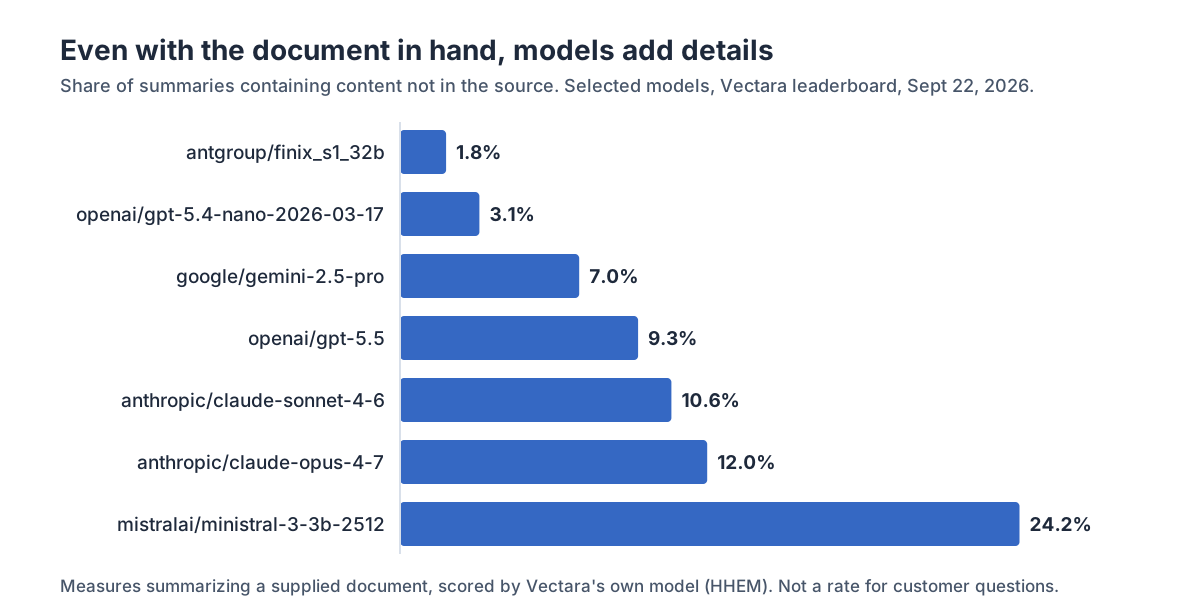
The short answer. AI chatbots give wrong answers when the information they read is missing, out of date or contradicts itself, when nothing tells them to say “I don’t know”, and because models sometimes add details that aren’t in the source at all. On Vectara’s hallucination leaderboard, a vendor benchmark of 108 models updated September 2026, models added unsupported content to between 1.8% and 24.2% of document summaries, with the source text in hand. Fix what the bot reads, and what it may say, before you change the AI.
Who this is for. You have a chatbot on your website, an AI receptionist, or an AI tool writing replies to inquiries, and it has said something wrong: an old price, a policy you don’t have, a promise you wouldn’t make. You want to know whether to fix it or turn it off.
Why does my AI chatbot make things up?
Partly because of how models are built, and partly because of what they’re given. Researchers at OpenAI and Georgia Tech wrote in 2025 that models hallucinate in part because “the training and evaluation procedures reward guessing over acknowledging uncertainty” (Kalai et al., Why Language Models Hallucinate, 2025). Ask a question it has no answer for and, unless it’s told otherwise, it may produce one anyway.
The other part is your information. OpenAI’s own accuracy guide says you need to supply context when “the model lacks contextual knowledge because it wasn’t in its training set”, when “its knowledge is out of date”, or when the task “requires knowledge of proprietary information” (OpenAI, Optimizing LLM Accuracy). Your prices, service area and refund policy are proprietary information. If the bot wasn’t given them, or was given two versions, it may fill the gap with a guess.
”AI just can’t be trusted, so why bother?”
That’s a fair reaction, and part of it is true: even with good information, AI tools still get things wrong. The answer is to design around it, not to assume it away.
A peer-reviewed measurement comes from law, where tools are built to answer from a curated source. Stanford researchers tested AI legal research tools from LexisNexis and Thomson Reuters on 202 preregistered questions. They found “the AI research tools made by LexisNexis (Lexis+ AI) and Thomson Reuters (Westlaw AI-Assisted Research and Ask Practical Law AI) each hallucinate between 17% and 33% of the time”, fewer than a general-purpose chatbot (GPT-4) but well above zero. The same paper notes that providers had touted retrieval as “eliminating” hallucinations; the authors call those claims “overstated” (Magesh et al., Journal of Empirical Legal Studies, 2025).
The model itself matters too, and no model on Vectara’s leaderboard scores zero. The chart shows a sample of the 108 models listed.
So the practical design is: give it one correct source, tell it to stay inside that source, give it a line for “I don’t know”, keep it away from decisions a person should make, and read what it says. Those steps are below. Leaving it unchecked carries its own risk: in the case below, a tribunal held the business responsible for what its bot said.
What happened with Air Canada’s chatbot?
A tribunal held the airline responsible for its chatbot’s wrong answer. In Moffatt v. Air Canada (2024 BCCRT 149, decided February 14, 2024), the chatbot “suggested Mr. Moffatt could apply for bereavement fares retroactively”, which Air Canada did not allow. The tribunal said Air Canada was in effect suggesting that “the chatbot is a separate legal entity that is responsible for its own actions”. The tribunal called that “a remarkable submission”, found that Air Canada “did not take reasonable care to ensure its chatbot was accurate”, and ordered it to pay $650.88 in damages plus interest and fees (Civil Resolution Tribunal decision).
Two details matter for any business. The correct policy was on another page of the same website, and the tribunal said Air Canada didn’t explain “why customers should have to double-check information found in one part of its website on another part”. The bot and the policy page disagreed, and the tribunal didn’t expect the customer to work out which was right. And this was one small-claims tribunal decision in British Columbia; it shows how one decision-maker saw it, not what a court near you would do.
A second case shows the gap problem. In April 2025, an AI support agent called “Sam” at Cursor, a software company, told a user that “Cursor is designed to work with one device per subscription as a core security feature.” Co-founder Michael Truell replied publicly: “We have no such policy.” eWeek reported that Cursor has since labelled AI-generated support responses (eWeek, April 2025). The bot stated a policy the company didn’t have.
What causes wrong answers, and what fixes each one?
Match the symptom you see to its likely cause, and start with the first fix in that row.
| What you see | Likely cause | First fix |
|---|---|---|
| Quotes last year’s price | Old file still loaded | Remove it; keep one price list |
| Two answers to one question | Sources disagree | Pick one source of truth |
| Invents a policy | Gap, no “I don’t know” rule | Write the policy and the rule |
| Offers a job you don’t do | No “what we don’t do” list | Add exclusions |
| Right fact, wrong situation | Exceptions not written | Write when it applies |
| Vague runaround | Source too thin | Add detail and examples |
| Promises a discount or date | No never-promise list | Add the list and a handoff |
| Wrong despite the right text | Model error | Narrow scope; review weekly |
Seven of the eight rows are fixed in what the bot reads or is allowed to say. Even the last one starts with scope and review, not a different vendor. If a pattern of wrong answers survives the first seven fixes, then compare models.
How do I fix a chatbot that gives wrong answers?
Work from the smallest change to the largest, and re-test after each one.
- Collect the wrong answers. Read recent conversations and list every answer you wouldn’t have given, with the question that triggered it.
- Remove stale sources. Take old price lists, draft pages and outdated PDFs out of whatever the bot reads.
- Settle conflicts into one source. Where the website, the profile and the document disagree, decide the true answer, write it once and fix the others. That single source is the start of a business brain.
- Add the “I don’t know” line and handoff rules. Tell it to use only the information provided, and write exactly what it says, and who follows up, when the answer isn’t there. For a phone receptionist, the full go-live list is in what your AI receptionist needs to know before it answers a single call.
- Narrow what it may answer. Turn off topics that need judgment: custom quotes, disputes, refunds, anything legal or medical. It can take details and pass them on instead.
- Fill one gap a week. Each question it couldn’t answer becomes a new written answer, approved by whoever owns that fact. Setting up that ownership is the core of our Business Brain & Knowledge Base project.
- Only then consider a different model or tool, and test it on the same questions so you’re comparing like with like.
Example, not a statistic. Your bot still reads an old page that lists a tune-up at $89; the current price is $129. Assume 15 people book through the bot in a month at the old price. That’s 15 × $40 = $600 you either honor or explain, one awkward conversation at a time. Use your own price gap and booking count; the fix (step 2) can take minutes.
Numbers we left out
These figures turn up in articles about AI wrong answers. We traced them and didn’t use them.
- “Vectara” hallucination rates on blogs and stat roundups. Secondary sites publish conflicting figures credited to Vectara. We used only the leaderboard on GitHub, with its update date.
- “Gartner: the average abandoned AI project costs $7.2M” and “42% of companies abandoned most of their AI initiatives.” Blogs credit both to Gartner. We couldn’t trace either to a Gartner publication.
Where this breaks down
- Fixing the information lowers the error rate; it doesn’t remove it. That’s why the “I don’t know” line, the scope limits and the weekly review stay in place.
- The measurements aren’t about small-business chatbots. The Stanford study tested legal research tools, and Vectara measures summarizing. They show that grounded AI still errs, not how often your bot will.
- Some questions shouldn’t go to a bot at all. Disputes, complaints and anything where the answer depends on judgment belong with a person.
- This isn’t legal advice. The Air Canada decision is one Canadian small-claims ruling. If a bot has made a promise to a customer, talk to your own adviser.
How Leadio does it
Leadio’s Business Brain & Knowledge Base project starts with the sources: the stale, conflicting and missing information behind rows 1, 2, 4, 5 and 6 of the table above. We review the material in scope, decide with you which sources count as current, agree how conflicting or outdated material is handled, and name who approves facts and who owns updates. It doesn’t assume automatic syncing with every source and doesn’t guarantee every answer is right. The result is one agreed set of current sources for your staff and any scoped agents to answer from.
When you need an agent built around a defined task, AI Agent Development scopes it: which information it may use, which actions it may take, and when it must ask a person. We test the agreed behaviour against examples your team reviews.
Bring the answers your bot keeps getting wrong and the people who own those facts: start with a Business Brain conversation.
FAQ
Why does my AI chatbot give wrong answers? Its information is missing, outdated or conflicting; nothing tells it to say “I don’t know”; or the model adds details that aren’t in its source. Check the first two before blaming the model.
How do I stop an AI from making things up? Give it one current source, tell it to answer only from that source, write the line it uses when the answer isn’t there, switch off topics that need judgment, and read its conversations. Techniques like these reduce errors but don’t remove them (Anthropic’s guidance says so; we quote it in what your AI receptionist needs to know), so keep reading the conversations.
Why does AI give different answers to the same question? An AI chatbot that generates its replies writes each one fresh rather than reading out a stored one, so wording can change and, where its information is thin or conflicting, so can the substance. Facts like prices should be written once, word for word, in the source it reads.
Is a business responsible for what its chatbot says? In Moffatt v. Air Canada, a British Columbia tribunal said yes for that airline: “It should be obvious to Air Canada that it is responsible for all the information on its website.” It is one small-claims decision, not a rule everywhere, and not legal advice.
Will a better AI model fix wrong answers? It may reduce them. On Vectara’s leaderboard, models range from 1.8% to 24.2% on one summarizing test. No model there scores zero, so the information, the limits and the review still matter.
Business Brain & Knowledge Base
Organise agreed business information so staff and scoped agents can use it.
More from run on better systems.
Your AI only knows what you write down: building a business brain your staff and your AI both run on
How to train AI on your business: write down how it works once, in one place, so a new hire, an AI receptionist and your follow-up all answer from the same facts. Includes a free outline of what a business brain should contain.
What your AI receptionist needs to know before it answers a single call
A go-live checklist for training an AI receptionist on your business: the decisions your website may not hold, from price ranges and service area to the never-promise list, the "I don't know" line and when a person takes over.
See where your leads are leaking.
Find out which stages are leaking, who we'd staff to plug them, and which Growth Team follows.