
Your AI only knows what you write down: building a business brain your staff and your AI both run on
How to train AI on your business: write down how it works once, in one place, so a new hire, an AI receptionist and your follow-up all answer from the same facts. Includes a free outline of what a business brain should contain.

The short answer. To train AI on your business, write down how the business actually works (services, prices or price ranges, policies, booking rules, what never to promise, and when a person takes over) in one place, and have every AI tool answer from that document. In a peer-reviewed 2021 study by Facebook AI Research on general-knowledge conversation tasks, the researchers’ best models, which looked up a knowledge source before replying, had over 60% fewer hallucinated responses than models that didn’t. The writing is the part only you can do.
Who this is for. You sell through an inquiry, an estimate or an appointment, and the answers customers need (what it costs, whether you cover their area, when you can come) mostly live in your head or in one or two people’s heads. You are thinking about an AI receptionist, a website chat or automated follow-up, or you just want a new hire to stop asking you the same ten questions.
What is a business brain?
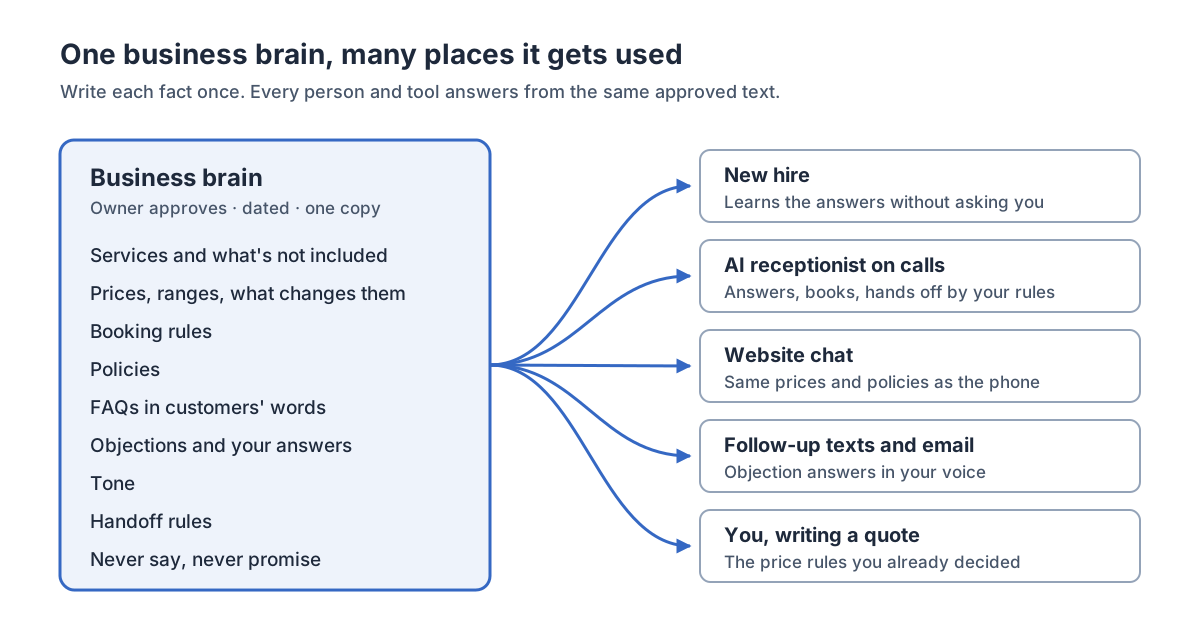
A business brain is one written source of truth for how your business works, kept current by a named owner, that both people and AI tools answer from. It holds your services, prices, policies, frequently asked questions, scripts, objection handling, tone and handoff rules.
It is not the same as three things it gets confused with:
- Your website was written for visitors. Check whether it leaves out the things you decide case by case: what changes a price, which jobs you turn down, what happens when someone calls at 9pm with water on the floor.
- An SOP manual tells staff how to do a task. A business brain tells anyone, or any AI, what to say when a customer asks a question.
- A “second brain” is a personal note system for one person’s ideas. A business brain is shared, approved and written to be acted on.
”I don’t have time to write all of this down”
You don’t need a manual. You need answers to the questions customers already ask, captured in the order they come up. EOS, the Entrepreneurial Operating System, describes documenting processes with a “high-level 20/80 approach”: capture “the 20% of the major steps that produce 80% of the results.”
The same idea works here. Start with the questions you answered this week, answer them out loud, and let the document grow each time someone asks something it doesn’t cover. If talking comes easier to you than writing, record the answers and edit the transcript. You add pages over months, not in one sitting.
Why does an AI need a business brain?
Because a model only knows what it was trained on plus what you hand it, and your current prices, exceptions and handoff rules may never have been in its training data. OpenAI’s own accuracy guide puts proprietary business information on its list of things you have to supply yourself (we quote it in why your AI chatbot gives wrong answers). Your price list is that kind of information.
Handing it the right information measurably helps. Shuster and colleagues at Facebook AI Research tested chatbots that retrieve documents before replying against ones that don’t. In automatic and human evaluations, their best retrieval models reduced hallucinated responses “by over 60%” (Findings of EMNLP 2021; arXiv). The study used general-knowledge conversation tasks, not small-business calls, but the idea is the same one behind an AI receptionist or chat that answers from your own documents: give it the facts first, then let it answer.
Grounding reduces errors but does not remove them, and in one Canadian case a tribunal held Air Canada responsible for what its chatbot told a customer. We cover both, with the measurements and the Air Canada chatbot case, in why your AI chatbot gives wrong answers.
Does a business brain only help the AI?
No. The same document trains a new hire, settles “what did we tell that customer?” and keeps your follow-up texts consistent with what the receptionist said on the call. The cost of hard-to-find knowledge was being estimated years before today’s AI chat tools: in McKinsey Global Institute’s 2012 analysis, built partly on IDC data about “interaction workers” at large organizations, 19% of working hours went to “trying to track down information needed to complete tasks” (McKinsey, The social economy, 2012). That study did not measure small businesses. In your business, ask yourself how many of those questions end up with you.
What should a business brain contain?
Our outline has twelve sections, built around what customers ask and what anyone answering for you needs to decide. Copy the outline below into a document and fill the sections in the order listed; the first six are enough to start.
Sections 5 and 6 matter more than their length suggests. They tell an AI what to do when the answer isn’t in the document; without them, it has no instruction for that moment and may guess. For the receptionist-specific version of this list, with the decisions to make before go-live, see what your AI receptionist needs to know before it answers a single call.
Where should your business knowledge live?
In one place that people and tools can both read, with a named owner. Here is how the usual homes compare.
| In your head | Your website | SOP manual | Business brain | |
|---|---|---|---|---|
| Who can use it | Only you | Visitors | Staff | Staff and AI tools |
| Prices and exceptions | Yes, unwritten | What you publish | Not its job | Written down |
| An AI can answer from it | No | Partly | Partly | Yes |
| Says when to hand off | In the moment | No | Sometimes | Yes |
| Who keeps it current | You | Whoever edits the site | Varies | A named owner |
The website and the SOP manual still matter. A business brain borrows from both; it doesn’t replace them. The difference is that it is written as answers, and someone owns keeping it true.
How do you build a business brain, step by step?
Start with the smallest version that covers the questions you get most, put it to work on one channel, and grow it from what customers actually ask.
- Collect the questions. Pull the last two weeks of texts, emails, form messages and call notes. List every question once, in the customer’s words.
- Answer them out loud. Record yourself answering, transcribe, and edit each answer to a few sentences. Mark anything that “depends” and write down what it depends on.
- Write the handoff rules and the never-promise list. Do this before any AI answers a customer. It is the part that limits damage when the document has a gap.
- Test it privately. Paste the document into an AI chat tool, tell it to use only that text and say “I don’t know” otherwise, and ask it the questions a customer would. Fix every wrong or missing answer.
- Put it to work on one channel. After-hours calls or website chat are a contained place to start. Read the conversations each week and add every question the document missed.
- Then widen it. Add prices in detail, objections and tone. Use the same document to onboard the next hire and to write follow-up messages.
When to go further: once more than one person or tool answers customers, or prices and policies change more than a few times a year, the document needs an owner, a review date and a way to push changes everywhere it’s used. That is the point where a managed project, such as our Business Brain & Knowledge Base, is worth considering.
How big is a business brain?
Smaller than you think. Here is a rough size, with the inputs shown so you can swap in your own.
Example, not a statistic. Assume 60 customer questions with answers of about 120 words each (7,200 words), plus a price list, booking rules and policies of about 3,000 words. That’s roughly 10,000 words. At an assumed 500 words a page, it’s about 20 pages.
For scale, Anthropic, which makes the Claude models, says that with its models, “if your knowledge base is smaller than 200,000 tokens (about 500 pages of material)”, you can “just include the entire knowledge base in the prompt” without a search system in between (Anthropic, Introducing Contextual Retrieval, 2024). A 20-page business brain is far under that. Swap in your own question count and see where yours lands. Size is not the hard part; keeping it correct is.
Numbers we left out
These figures turn up in articles about knowledge bases. We traced them and didn’t use them.
- “Employees spend 1.8 hours a day searching for information (McKinsey).” It isn’t in the McKinsey report, which says 19% of working hours for large-company interaction workers. A trace by Ainora traces the related “9.3 hours a week” to a 2013 guest post, written by a knowledge-management vendor’s employee, that names no report.
- “Strong onboarding improves new-hire retention by 82% and productivity by over 70%.” Credited to Brandon Hall Group and Glassdoor. We found no primary report, year or sample behind it.
- “Teams can verify only 8–12% of their knowledge” and “AI amplifies errors 100–1000x.” From a Guru blog post that attributes them to unnamed interviews or gives no source.
Where this breaks down
- A business brain doesn’t make AI perfect. Grounded tools still make mistakes. That is why the handoff rules, the “I don’t know” line and a weekly read of conversations stay in place.
- An out-of-date brain gives out-of-date answers. It needs an owner and a review date, or it becomes another source that disagrees with the truth.
- Judgment stays with people. Discounts, disputes, complaints and anything unusual go to a person. The document says when; it doesn’t decide for you.
- Keep private material out. Customer records, staff pay and your margins don’t belong in what a customer-facing AI reads.
- If one person answers every inquiry and likes it that way, a one-page FAQ may be all you need for now.
How Leadio does it
Leadio’s Business Brain & Knowledge Base is a separately scoped project. We review the material your team relies on, decide with you which sources count as current, organise the agreed information for the staff and agent tasks that need it, and agree who can use each part, who approves facts and who owns future updates. It doesn’t assume automatic syncing with every source, and it doesn’t guarantee every answer is correct. It is the work that makes the answers checkable.
It is optional, not a required add-on. The organised knowledge is then ready for your staff and for a scoped AI agent. If you also use the 24/7 Answering Service, 24/7 Chat & DMs or the Lead Nurture Ladder, it gives you one approved set of answers to configure them from.
Bring the information your team struggles to find and the people who own its accuracy: start with a Business Brain conversation.
FAQ
How do I train AI on my business? Write down your services, prices or ranges, policies, booking rules, never-promise list and handoff rules in one document, then give that document to the AI and tell it to answer only from it and to say “I don’t know” otherwise. Test it with real customer questions before it talks to anyone.
What is a business knowledge base? A written collection of the facts and answers people need to work in or with your business. A business brain is a knowledge base written as answers, approved by a named owner, and used by both staff and AI tools.
What should not go in a knowledge base an AI reads? Customer records, payment details, staff information, internal margins and anything you wouldn’t want read aloud to a customer. Keep those in your other systems.
How often should a business brain be updated? Whenever a price, policy, service or hour changes, and on a fixed review date as a backstop. Add each question the AI or a new hire couldn’t answer as it comes up.
Is a business brain the same as a “second brain”? No. A second brain is one person’s note system. A business brain is shared, approved and written so that someone, or something, can act on it.
Business Brain & Knowledge Base
Organise agreed business information so staff and scoped agents can use it.
More from run on better systems.
What your AI receptionist needs to know before it answers a single call
A go-live checklist for training an AI receptionist on your business: the decisions your website may not hold, from price ranges and service area to the never-promise list, the "I don't know" line and when a person takes over.
Why your AI chatbot gives wrong answers, and the fixes that don't need a new AI
Why AI chatbots quote the wrong price or invent a policy: missing, outdated or conflicting information, no permission to say "I don't know", and models that add details even with the right document. A symptom-by-symptom fix list, smallest change first.
See where your leads are leaking.
Find out which stages are leaking, who we'd staff to plug them, and which Growth Team follows.